
Mobile Growth Funnel Stages: A Practical Guide
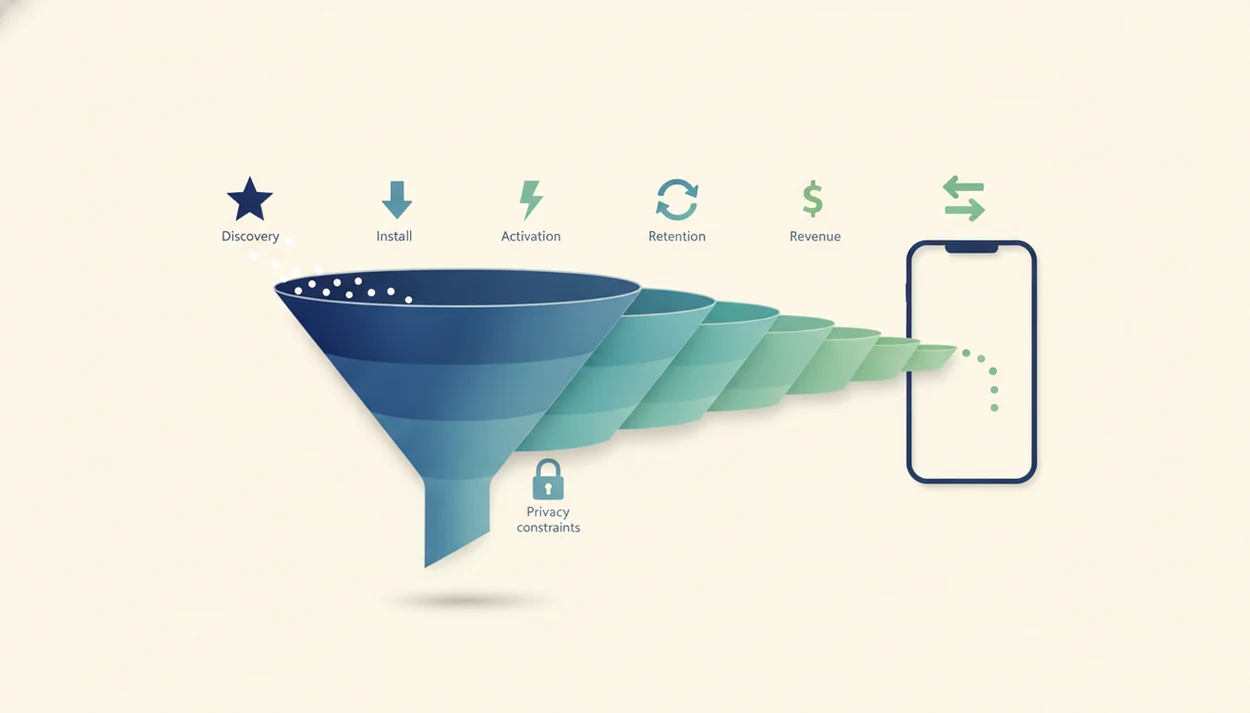
A mobile growth funnel is the lifecycle path that moves people from awareness to install, activation, retention, revenue, and referral. The useful version is not a download chart; it is a measurement and experimentation system that shows where mobile users drop off and which stage deserves the next product or marketing fix.
> Definition: A mobile growth funnel is a stage-based model for tracking how app users discover, install, use, pay for, and recommend a mobile product over time.
TL;DR
- The core mobile growth funnel stages are awareness, acquisition, activation, retention, revenue, and referral.
- The best funnels use stage-specific KPIs such as install-to-signup rate, Day-1 retention, Day-30 retention, ARPU, LTV, and referral rate.
- Mobile funnels need privacy-aware measurement because iOS ATT, SKAN, app store rules, and attribution gaps can distort what teams think is working.
- Retention usually matters more than raw installs because many apps are abandoned quickly after download.
- A strong funnel is run by product, marketing, CRM, and data teams together, not by paid acquisition alone.
Mobile Growth Funnel Definition and At-a-Glance Stages
A mobile growth funnel is a practical stage map for turning unknown prospects into active, retained, paying, or referring app users. In most mobile teams, the six common stages are awareness, acquisition, activation, retention, revenue, and referral.
The model is useful because it separates store listing discovery from install quality, first-session value, repeat use, monetization, and sharing. A founder checking keyword rank in a spreadsheet before coffee may see the same term move from position 18 to 23, but that alone does not explain whether new users stayed or paid.
For mobile teams, the funnel should optimize long-term engagement and lifetime value, not install volume alone. The safer reading is simple: adapt the funnel by app category, platform, country, and business model before treating any benchmark as a target. A fitness subscription, a casual game, and a banking app do not have the same drop-off pattern.
Five Mobile Growth Funnel Facts Teams Should Know
These five facts explain why the mobile growth funnel is an operating system, not a slide in a pitch deck. According to DataReportal’s 2023 global overview, mobile apps accounted for about 58% of global web traffic and more than 92% of time spent on mobile devices (DataReportal, Digital 2023 Global Overview Report: DataReportal so the quality of mobile experience affects the whole growth system.
- Fact 1: Mobile funnel stages typically run from awareness through referral, with acquisition, activation, retention, and revenue between them.
- Fact 2: The goal is sustainable engagement, retention, lifetime value, and revenue, not install volume alone.
- Fact 3: Each stage needs its own KPI and event instrumentation, or the dashboard becomes decoration.
- Fact 4: Funnel improvement is cross-functional across product, marketing, CRM, data, and sometimes monetization.
- Fact 5: Personalization, automation, and privacy-aware measurement are now required because ATT, SKAN, and attribution limits reduce certainty.
Open Apple Developer documentation in one tab and Google Play policy in another before changing metadata. That dull routine prevents expensive funnel errors.
How the Mobile Growth Funnel Works Behind the Scenes
A mobile growth funnel works by tracking user state transitions: stranger, visitor, installer, activated user, retained user, payer, and advocate. Events, cohorts, attribution, and segmentation turn that behavior into measurable stages.
The mechanism is not strictly linear. A user may install from a branded search, ignore the app for a week, return after a push notification, buy after a paywall test, then refer a friend after a useful milestone. That loop is why lifecycle stage matters more than a single source label.
In practice, teams compare cohorts by acquisition source, platform, country, campaign, onboarding path, and app version. They also compare first-time and returning users because a reinstall behaves differently from a fresh install. A Statista mobile app usage chart reports that roughly one-quarter of downloaded apps are opened only once, which is why activation and early retention deserve attention before another paid campaign is funded: Statista That is why activation and early retention deserve attention before another paid campaign is funded.
The session replay paused on confusion tells the story faster than the chart.
Before You Start: Mobile Growth Funnel Prerequisites
Before building a mobile growth funnel, make the business goal, activation signal, data quality, privacy assumptions, and ownership model explicit. This prevents the first dashboard from becoming a polished argument about undefined events.
- Confirm the primary business outcome. Choose the result the app must improve, such as a subscription, booking, transfer, purchase, or durable weekly use, before assigning users to funnel stages.
- Define the early activation event. Pick the first meaningful action that proves a new user reached value, not just opened the app or tapped through onboarding.
- Audit the event taxonomy. Check for duplicate events, missing names, inconsistent properties, and version drift across iOS, Android, attribution, CRM, and analytics tools.
- Check privacy and attribution constraints. Review consent flows, ATT or platform limits, SKAN assumptions, deferred deep links, and any modeled reporting before treating source data as exact.
- Assign the operating rhythm. Agree on one reporting cadence and name one owner for each stage, so activation, retention, revenue, and referral do not become everyone’s side project.
A clean prerequisite pass is slower than opening a dashboard, but it saves weeks of arguing over broken numbers.
How to Use a Mobile Growth Funnel in Practice
Use a mobile growth funnel by defining one business outcome, mapping app events to lifecycle stages, and reviewing stage movement on a recurring cadence. The process should stay vendor-neutral, because the hard part is deciding what counts.
- Set the business goal and primary conversion outcome. Choose one main outcome, such as paid subscription, completed booking, first transfer, or weekly active use.
- Map lifecycle stages to actual app events. Tie awareness, acquisition, activation, retention, revenue, and referral to tracked events inside the app and store journey.
- Segment by acquisition source, platform, country, first-time versus returning users, and monetization status. A blended funnel hides too much.
- Measure stage KPIs with analytics, attribution, cohorts, and privacy-aware reporting. Treat modeled reporting as a signal, not a receipt.
- Run experiments and review the funnel in a recurring growth ritual. Record the hypothesis, audience, metric, result, learning, and next action.
For early teams, app analytics for beginners is often easier than a heavyweight warehouse project because it forces clear event names first.
Mobile Growth Funnel KPI Table by Stage
A mobile growth funnel becomes useful when each stage has a user question, a core KPI, and a small set of levers. KPI definitions must stay consistent across analytics, attribution, CRM, and store reporting tools.
| Stage | User question | Core KPI | Common levers |
|---|---|---|---|
| Awareness | “Have I heard of this app?” | Impressions, reach, branded search, store page views | Positioning, audience, creative, category fit, ASO keywords |
| Acquisition | “Should I install it?” | Install rate, cost per install, install source mix, app store conversion rate | Store listing, screenshots, reviews, ratings, campaign relevance, deep links |
| Activation | “Did I get value?” | Install-to-signup rate, onboarding completion, first key action, time to value | Permissions timing, onboarding flow, empty states, personalization |
| Retention | “Is it worth returning?” | Day-1, Day-7, Day-30 retention, churn, session frequency | Lifecycle messaging, habit loops, content cadence, winback flows |
| Revenue | “Is it worth paying?” | Conversion to paid, ARPU, ARPPU, LTV, payback period | Pricing, trials, paywalls, bundles, value communication |
| Referral | “Should I share it?” | Invite rate, share rate, viral coefficient, referred-user retention | Share prompts, reward design, post-success moments |
A cramped release note field can still affect the revenue row if it promises a fix that users expected last week.
Mobile Funnel Stage-by-Stage Optimization Steps
Mobile funnel optimization means choosing the weakest stage, changing one lever, and measuring whether the next cohort improves. Global consumer spending on mobile apps reached about $167 billion in 2022, according to data.ai State of Mobile 2023, but revenue only appears when users keep finding value.
Awareness and acquisition levers
Clarify positioning, audience, creative, ASO keywords, category fit, and landing pages. Then improve the store listing, screenshots, reviews, ratings, campaign relevance, and deep links. Ad creative thumbnails scattered across tabs usually signal too many messages and not enough positioning discipline. The deeper mobile user acquisition work starts there.
Activation and retention levers
Reduce permissions friction, shorten onboarding, guide the first key action, and personalize the early experience. Build lifecycle messaging, habit loops, content cadence, meaningful notifications, and winback flows. For consumer apps, retention work usually beats more acquisition when first-session value is unclear.
Revenue and referral levers
Test pricing, trials, paywalls, subscription prompts, bundles, and value communication. Add share moments after user success, not before value is felt. Too soon feels needy.
Mobile Growth Funnel Segmentation and Privacy Constraints
One blended mobile funnel hides the real drop-off points. Teams should split performance by paid versus organic, iOS versus Android, new versus returning users, country, campaign, app version, and subscription plan.
Privacy rules make this harder. iOS App Tracking Transparency limits user-level tracking without permission, and SKAN gives aggregated campaign measurement rather than full deterministic attribution. Deep links may also lose context across install paths, store redirects, consent states, and deferred routing. Before you submit, compare the policy text against the workflow instead of assuming the analytics plan is allowed.
Use modeled reporting, cohort trends, incrementality tests, and first-party events where appropriate. Attribution tools can disagree because they use different windows, device signals, and matching rules. The Play Console pre-launch report screenshot with red accessibility and crash markers is a useful reminder: platform data, app data, and marketing data each show only part of the funnel.
Mobile Growth Funnel Team Process and Experiment Rhythm
A mobile growth funnel needs an operating rhythm with product, marketing, lifecycle or CRM, design, engineering, analytics, and monetization where relevant. Each stage should have one owner, one KPI definition, and one shared dashboard.
Weekly or biweekly reviews work best when the format stays plain: hypothesis, audience, metric, result, learning, and next action. Prioritize experiments by impact, confidence, effort, and guardrail risk. Guardrails matter because a short-term paywall win can raise refunds, hurt reviews, or reduce notification permission rates.
Bain research has reported that improving customer retention by 5% can increase profits by 25–95% (Bain & Company, Prescription for Cutting Costs: MediaPrescriptioncutting_costs.pdf). That range is broad, but it explains why executives should not leave retention to lifecycle messages alone. Good independent guides on mobile app product, growth, app store discovery, shipping, and industry trends deliver policy-aware checklists and tradeoffs, not agency jargon or pay-to-rank shortcuts. Tools like Power Themes can sit beside official docs in that review habit.
Common Mobile Growth Funnel Mistakes
The most common mobile growth funnel mistakes come from treating a lifecycle system like a campaign report. These errors show up quickly when the App Store Connect yellow warning banner appears before a build is submitted for review and the team still has no shared KPI language.
- Install worship: Treating installs as the main success metric ignores activation, retention, revenue, and referral quality.
- Copy-paste funnel design: Borrowing another app’s funnel without category, platform, country, or business model context creates false targets.
- Linear thinking: Assuming the funnel is one-way misses loops between engagement, monetization, referral, and winback.
- Paid-ad masking: Using paid ads to compensate for weak onboarding or retention raises cost without fixing product value.
- Short-term extraction: Over-optimizing clicks, trials, or purchases can damage trust, reviews, and brand equity.
- Messy instrumentation: Duplicate events, missing events, and inconsistent attribution windows make stage comparisons unreliable.
For deeper retention language, app retention metrics should be defined before the dashboard review starts.
Limitations
A mobile growth funnel is a simplified model. It helps teams make decisions, but it can also hide messy behavior that does not fit a clean stage chart.
- Funnel models may miss nonlinear patterns, such as users who churn, return, pay, then go dormant again.
- Data quality problems can distort every stage, including duplicate events, missing events, and inconsistent naming.
- ATT, SKAN, consent choices, and privacy rules reduce user-level measurement precision.
- Benchmarks from games, social apps, fintech, B2B SaaS, and utilities may not transfer.
- Virality, word of mouth, featuring, and algorithmic discovery are hard to predict or control.
- Short-term conversion optimization can damage trust, notification permission rates, reviews, and long-term retention.
- Small apps may not have enough traffic for statistically reliable experiments.
- Funnel dashboards can create false certainty if interviews, support tickets, and usability research are ignored.
Power Themes treats funnel work as product operations, not a guarantee of growth. The safer move is to pair quantitative cuts with qualitative evidence.
FAQ
What is a growth funnel?
A growth funnel is the path people take from awareness to conversion and ongoing value. It helps teams see where prospects or users drop off.
What is a mobile funnel?
A mobile funnel applies that model to app discovery, install, first use, repeat use, payment, and referral. It should include store, app, and lifecycle behavior.
What are funnel stages?
Common mobile funnel stages are awareness, acquisition, activation, retention, revenue, and referral. Each stage describes a different user decision.
Why do mobile funnels matter?
Mobile funnels reveal where users stop moving forward. Teams use them to improve engagement, retention, revenue, and referral quality.
Which funnel metrics matter most?
The most useful metrics depend on the stage. Common ones include install-to-signup rate, Day-1 retention, Day-30 retention, ARPU, LTV, and referral rate.
Is AARRR still useful?
AARRR is useful as a simple starting model. Mobile teams should adapt it for app stores, onboarding, subscriptions, privacy rules, and platform differences.
How do apps improve retention?
Apps improve retention by improving onboarding, creating habit loops, sending relevant lifecycle messages, and making product value clear. Churn reduction strategies should connect to actual user behavior, not generic reminders.
How is mobile attribution changing?
Mobile attribution is becoming more privacy-constrained because of ATT, SKAN, consent rules, and platform limits. Teams increasingly rely on cohorts, incrementality, first-party events, and modeled reporting.