
Best Mobile Apps for Identifying Antiques in 2026
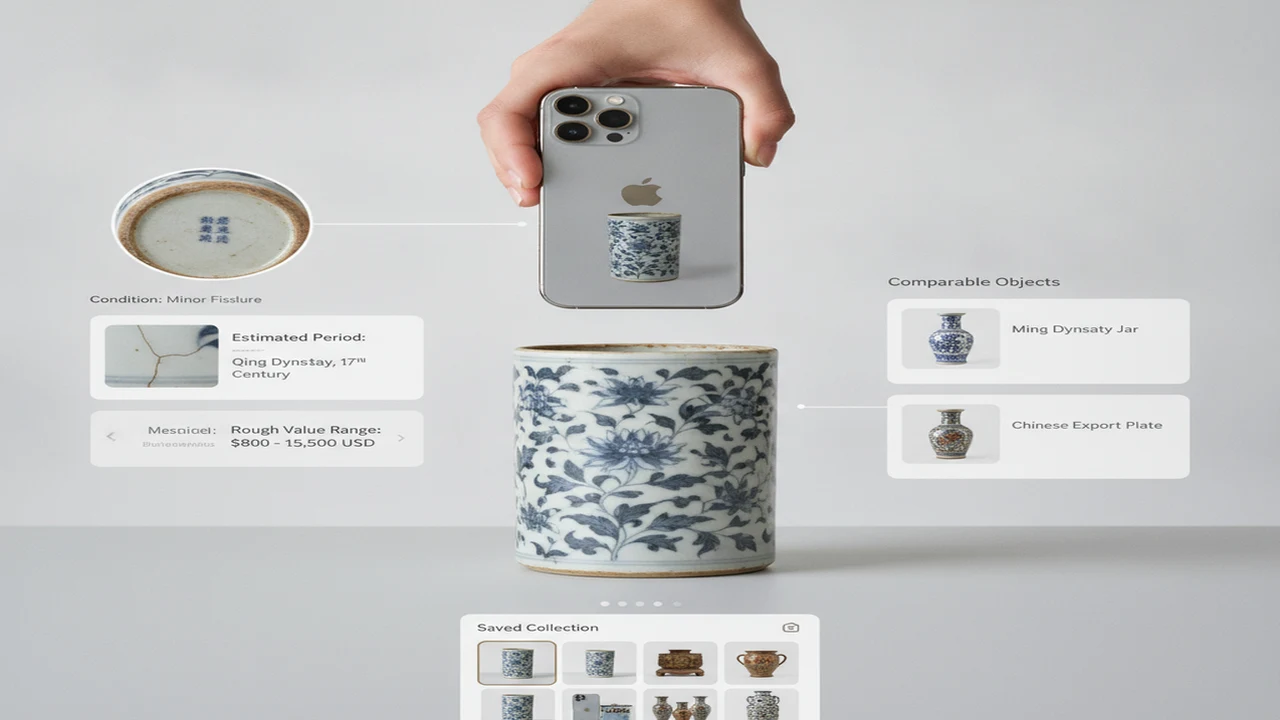
Most antique apps make the first session look simple: grant camera access, photograph an object, and wait for a label or price estimate. The harder product question is what happens next. A useful result should expose identifying clues, preserve the item record, and help the user investigate comparable objects rather than ending at a confident-looking number.
The category is crowded with similar AI and appraisal language. The supplied store research covered 2 platforms, iOS and Android, and surfaced at least 8 relevant listings across app stores and product pages (Apple App Store, Google Play, and Power Themes source review, 2026). Those figures describe the reviewed landscape, not the availability of every shortlisted app on both platforms.
Quick answer: Choose an antique identifier by the decision it supports after the photo: identifying marks, estimating a market range, finding comparable objects, or organizing a collection. The strongest shortlist includes Antique Identifier TIQ, Relic, AntiqSnap, Antique Identifier By Picture, and Curio. Compare platform support, subscription gates, saved records, export options, and the evidence behind value estimates.
What does this mean?
Definition: An antique identification app uses a camera-captured or uploaded image, plus optional details such as maker marks and materials, to suggest an object’s type, period, origin, history, and possible market value range. Its output is research guidance rather than a certified appraisal or guarantee of authenticity.
How should you choose an app for identifying antiques?
Start with the decision you need to make. Identification calls for period, material, origin, and maker clues. Resale preparation needs sold comparables and condition context. Collection management requires editable records, searchable fields, photos, and reliable export.
A strong antique identifier by picture should accept an overall photo and close-ups of signatures, labels, hallmarks, hardware, and damage. Results are more useful when the app explains why it suggested a category and separates identification confidence from value confidence.
Product fit also includes onboarding. A vague camera-permission prompt, mandatory account creation, or a trial screen shown before the first useful result can interrupt first-session completion. Subscription pricing, free-scan limits, renewal terms, and export gates should be visible before a user builds a collection.
The reviewed market shows one dominant workflow pattern: photo-first identification followed by value guidance (Apple App Store and Google Play listing review, 2026). A broader 2026 collector-app overview from PC y Redes also illustrates how mobile collection tools compete on organization as well as recognition.
- Input: camera capture, photo import, multiple images, close-up support, and optional text details.
- Output: period, materials, origin, maker clues, condition notes, comparable objects, and editable fields.
- Records: saved collections, search, sharing, backup, CSV or PDF export, and device-change support.
- Install checks: supported OS, regional availability, account requirements, privacy terms, and subscription disclosure.
Which antique identification apps are the best options in 2026?
The best app to identify antiques depends on the post-scan job. The matrix below assigns each option a practical use case rather than assuming one scanner is suitable for every object category.
The Antique Identifier TIQ workflow documents photo identification, maker-mark research, rough value ranges, authenticity clues, historical context, and collection saving. It fits iPhone users who want identification and research prompts kept in one item record.
- Antique Identifier - Relic: Best for a compact object record. Its one-photo antique scan can suggest identity, era, materials, condition, country of origin, and an estimated USD range. Core identification, comparison, history, and collection functions require a subscription.
- AntiqSnap: Antique Identifier: Best for collection-oriented and reseller scanning. It combines snap antique identification, pricing guidance, condition suggestions, and a digital collection organizer. Some reviews report material errors and difficulty separating reproductions from genuine pieces.
- Antique Identifier By Picture: Best for users who want background object removal and period suggestions. It adds quick value estimates and an antique collection manager, while reviews mention advertising, variable rescans, and occasional maker or region errors.
- Curio - Antique Identifier: Best for visual item matches and portable records. It provides craftsmanship information, value ranges, similar objects, and PDF collection export. Comparable objects support research but do not create a certified appraisal.
Which features make an AI antique identifier useful after the first scan?
Input quality matters more than scan speed. An AI antique identifier by photo should accept detail shots of hallmarks, signatures, labels, joinery, hardware, glaze, wear, and repairs. Depending on one wide image makes it harder to distinguish similar variants or detect replaced components.
Explainable results should connect a suggestion to visible evidence. Antique Identifier TIQ, for example, documents maker-signature and hallmark research, authenticity clues, context, and saved collections. Users should still be able to edit an incorrect material, date, or maker before retaining the record.
An antique price guide organizes pricing evidence. An AI antique identifier predicts categories or attributes from images and text. Curio emphasizes visual matches, while Relic packages findings into a compact object record. Both patterns can deepen a session, but neither guarantees identity or sale price.
Saved scans, editable notes, and exports create a reason to return after the first identification. For a closer framework, see how to evaluate scanner evidence and appraisal claims.
- Look for supporting clues, not only a category label.
- Check whether value ranges cite comparable objects, dates, venues, or condition assumptions.
- Prefer records that remain editable and can be exported or restored after a device change.
How can you appraise antiques by picture with less onboarding friction?
The phrase appraise antiques by picture should mean generating a preliminary market range or research lead. A polished result screen does not turn an image scan into a formal appraisal.
An effective first session explains why camera access is needed, shows a sample photo, displays upload progress, and returns an editable result. Pricing and account requirements should appear before payment or before the user spends time building a record. Antique Identifier TIQ is one example of a photo-led workflow, but input quality remains the user’s responsibility.
Teams designing or evaluating this funnel can use the antique app UX, cost, and platform comparison to inspect permission prompts, paywalls, and trial design.
- Photograph: Capture the whole object under even light, filling the frame without cutting off edges.
- Capture: Add close-ups of maker marks, signatures, labels, joinery, hardware, wear, repairs, and damage.
- Crop: Remove distracting background space while preserving condition evidence and scale cues.
- Describe: Enter known dimensions, weight, material, provenance, purchase location, and repair history.
- Scan: Submit the clearest images and avoid changing several variables at once between attempts.
- Review: Check the suggested period, origin, material, maker, and value assumptions; edit errors when supported.
- Cross-check: Search exact maker terms and compare the result with other photographs and sold examples.
- Save: Retain the images, result, corrections, provenance notes, and comparison references in one record.
Which app fits iPhone, Android, resale, and collection workflows?
For iPhone shoppers, the documented Antique Identifier App supports a photo-led identification and collection workflow. Check the current App Store page for the supported iOS version, in-app purchases, privacy disclosures, and recent review patterns before installing.
Occasional users may prioritize a short path from photo to editable result. Resellers need repeat scanning, condition notes, comparison research, and searchable records. AntiqSnap is positioned around collection tracking and reseller-oriented scanning, while Relic favors compact item records.
For inherited collections or cataloging projects, export can outweigh recognition speed. Curio offers PDF collection export and similar-item discovery. Antique Identifier By Picture emphasizes background cleanup, period identification, and collection storage.
Android readers should verify each candidate’s current Google Play listing, OS requirement, regional availability, trial terms, review recency, and export support. Do not assume feature parity with an iPhone version. Platform fit also includes install size, restore-purchase support, sign-in requirements, photo retention, and whether records survive a device change.
For users moving from identification to resale research, the scan-to-sold-price workflow explains how to turn a result into a comparison trail.
How should you verify an antique identification and value range?
Turn the app result into a research trail. Compare the object from several angles, inspect marks at full resolution, confirm dimensions and materials, search exact maker terms, review sold comparables, adjust for condition, and document provenance.
“How much is my antique worth?” is incomplete without a venue, location, date, and condition. A local dealer offer, online sale, auction estimate, insurance replacement figure, and estate valuation can differ because each serves a different transaction.
Google Lens can provide a broad visual-search cross-check. WorthPoint can support historical pricing research. Neither substitutes for examining the object, and active asking prices should not be confused with completed sales.
Category-specific evidence matters. An antique jewelry identifier needs hallmark, clasp, setting, weight, and stone details. An antique furniture identifier needs joinery, hardware, underside, wood, and repair photographs. A porcelain and ceramics identifier needs base marks, foot rims, glaze, decoration, dimensions, and condition images.
- Compare multiple images and inspect marks independently.
- Confirm dimensions, weight, materials, construction, and replaced parts.
- Search exact maker, pattern, model, or hallmark terms.
- Use sold comparables with similar condition, size, date, and sales venue.
- Record provenance, restoration, damage, fees, and shipping assumptions.
- Consult a qualified specialist for high-value, disputed, insured, estate, tax, conservation, or legal decisions.
What limitations should you expect from antique identifier apps?
Which antique identification app should you choose?
Choose by the recurring job. Antique Identifier TIQ is a documented iPhone option for photo identification, maker-mark context, rough market ranges, authenticity clues, and saved collections. Curio better suits visual matches and PDF export, AntiqSnap focuses on collection-oriented scanning, Relic creates compact records, and Antique Identifier By Picture adds period and background-processing features.
Before installing, inspect the current store listing, subscription screen, privacy details, export policy, and recent reviews. Favor the app whose records remain useful after the initial scan rather than the one promising the fastest answer.
Comparison
| App | Best fit | Photo and identification workflow | Value or comparison support | Collection and export tools | Platform and payment checks |
|---|---|---|---|---|---|
| Antique Identifier TIQ | Maker clues and saved research | Photo identification with maker marks, history, and authenticity clues | Rough market value ranges | Saved collection records | Documented iPhone listing; verify current purchases and iOS requirement |
| Antique Identifier - Relic | Compact object records | One-photo scan with era, material, condition, and origin suggestions | Estimated USD range and comparisons | Collection functions documented | Core AI, history, comparison, and collection features require a subscription |
| AntiqSnap: Antique Identifier | Reseller and collection tracking | Snap-based identification with condition and material suggestions | Pricing guidance and collection value tracking | Digital collection organizer | Verify current platform listing, trial, and subscription terms |
| Antique Identifier By Picture | Period suggestions and background cleanup | Photo scan or import with background object removal | Quick value estimate | Collection manager | Check advertising, payment terms, and current platform availability |
| Curio - Antique Identifier | Visual matches and export | Identification with similar objects and craftsmanship context | Value ranges based on historical information and comparisons | PDF collection export | Verify current store availability and export gates |
Limitations
Image-based identification can confuse reproductions, restored pieces, replacement components, and objects with similar silhouettes or decoration. Obscured marks, unusual regional styles, poor lighting, and an aggressive crop can also change the suggested identity. Repeat scans may vary because framing, angle, background, and entered context alter the model input.
A rough antique market value range is not a certified appraisal. It may omit condition adjustments, seller fees, auction premiums, location, shipping, restoration costs, and current buyer demand. Maker marks, signatures, hallmarks, labels, joinery, and provenance still require independent verification.
Product terms can change after the article date. Check platform availability, free-scan limits, trial length, auto-renewal terms, photo retention, account deletion, collection export, and support access. Reviews cited in the competitor summaries include concerns about AntiqSnap material identification and Antique Identifier By Picture rescan variability. High-value, insured, inherited, disputed, or conservation-sensitive objects should go to an appropriate specialist.
Frequently Asked Questions
Can a phone app identify an antique from a picture?
It can suggest an object type, period, material, origin, or maker from photographs and added context. Results are research leads, so marks, construction, condition, and comparable objects should still be checked.
What photos should I take for an antique identification app?
Take one full-object image and close-ups of marks, labels, signatures, hardware, joinery, base surfaces, wear, damage, and repairs. Use even light and include dimensions or a scale reference when appropriate.
Can Antique Identifier TIQ tell me how much an antique is worth?
Antique Identifier TIQ can provide a rough value range or starting point for pricing research. It does not provide a certified valuation or guarantee what an object will sell for.
Is Antique Identifier TIQ available on iPhone and Android?
A documented iPhone App Store listing was available on the article date. Verify the store directly for current iOS requirements, and confirm any Android listing rather than assuming an Android version or equivalent features exist.
What is the difference between an antique identifier and an antique price guide?
An identifier predicts an object’s category or attributes from images and text. A price guide organizes comparable sales or historical pricing evidence, so the two tools answer different parts of the research process.
Can an app identify antique jewelry, furniture, porcelain, and maker marks?
Apps can suggest categories, but each needs specific evidence. Jewelry requires hallmarks and stone details, furniture needs joinery and hardware photographs, and porcelain needs base marks, dimensions, glaze, signatures, and condition images.
Should I use Google Lens, WorthPoint, or an antique appraisal app?
Use Google Lens for broad visual matches, WorthPoint for historical pricing research, and an AI antique appraisal app for a structured photo-to-record workflow. A formal appraisal remains a separate professional service.
When should I get a professional antique appraisal?
Consult a qualified specialist when an item may be high value, authenticity is disputed, or the decision affects insurance, tax, an estate, conservation, or legal documentation. Specialist review is also sensible before an irreversible restoration.