
Subscription App Economics Explained
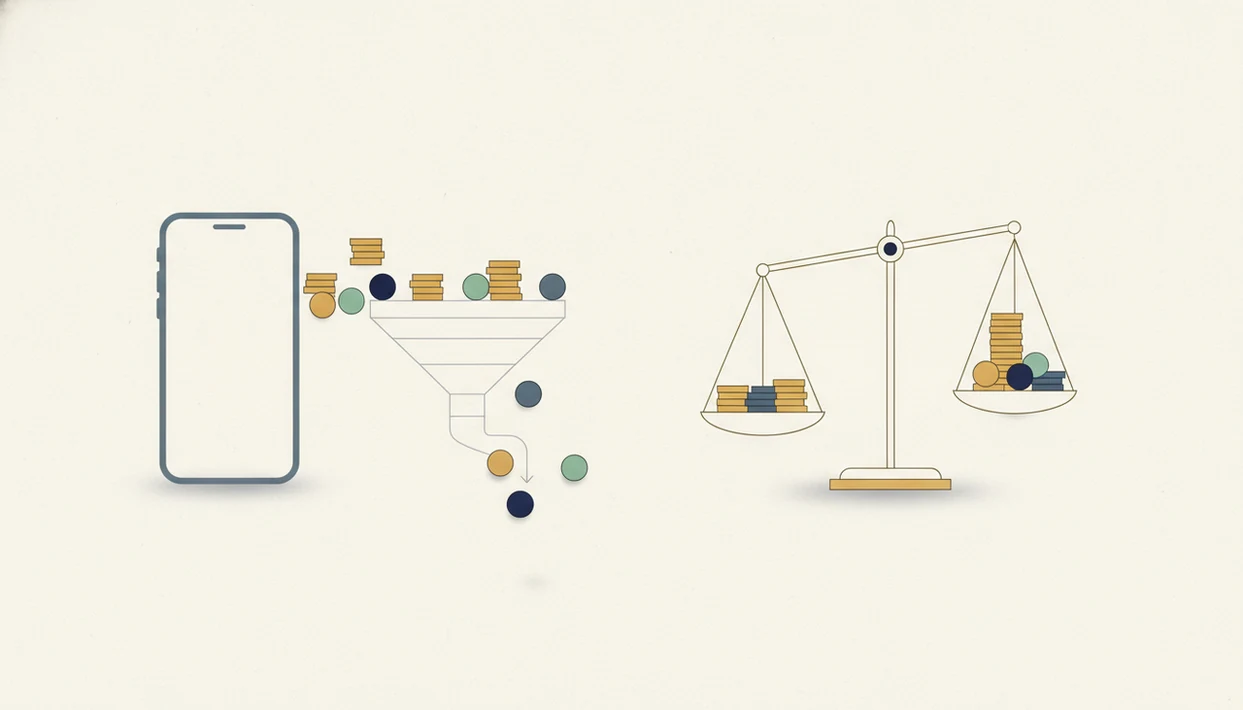
Subscription app economics is the way recurring-revenue apps turn pricing, acquisition cost, retention, churn, app store fees, and customer lifetime value into a sustainable business model. The practical test is simple: a subscription app works economically only when net lifetime value meaningfully exceeds customer acquisition cost within a payback window the team can afford.
> Definition: Subscription app economics is the financial model for measuring whether an app that charges recurring fees can acquire, retain, and monetize users profitably over time.
TL;DR
- The core equation is not downloads or rankings; it is net LTV versus CAC after churn, fees, refunds, taxes, and payment failures.
- Retention usually has more leverage than acquisition because small churn improvements can compound across every subscriber cohort.
- Mobile subscription apps need category-specific models because App Store and Google Play discovery, ratings, trials, and platform fees change the economics.
Subscription App Economics At a Glance
Subscription app economics measures whether recurring payments for ongoing access produce profitable, durable revenue. The main inputs are price, conversion rate, CAC, retention, churn, LTV, payback period, app store fees, refunds, taxes, and failed payments.
Gross subscription revenue is not the same as profitable revenue. A $9.99 monthly plan can look healthy in a dashboard, then shrink after Apple or Google fees, trial drop-off, refund requests, and paid acquisition costs. We see this most clearly when a founder checks keyword rank in a spreadsheet before coffee and the same term has slipped from position 18 to 23. The ranking moved, but the economic question stayed unchanged.
For consumer mobile teams, net LTV versus CAC is the practical center of the model because it connects store discovery, product value, and cash timing.
Five Subscription App Economics Facts Teams Should Know
- Recurring revenue changes planning. Subscriptions shift the business from one-time sales to renewal-based cash flow, so forecasts must follow cohorts over time.
- LTV must exceed CAC by a useful margin. A subscription app can grow revenue and still lose money if paid subscribers cost too much to acquire.
- Platform fees reduce gross revenue. App store and payment fees can remove 15–30% of gross subscription revenue. Apple documents its subscription commission structure here: Apple Developer documentation and Google explains Play service fees here: Google Support. before support, product, tax, and marketing costs.
- Retention compounds. Upgrades, annual plans, and lower churn often matter more than chasing constant new installs from paid campaigns.
- Subscription fatigue is real. In a 2022 Pew survey, 61% of consumers said they were concerned about the number of subscriptions they pay for. Source: Pew Research Center, 2022: Pew Research Center
A retention dashboard glowing in a dark office usually tells the truth faster than a launch-day download chart. Renewals are where the model proves itself.
How Subscription App Economics Works Behind the Numbers
Subscription app economics works by following users from install to trial, paid conversion, renewal, possible upgrade, and eventual churn. Each stage changes the expected value of a subscriber cohort.
A cohort is a group of users who signed up during the same period, such as January trial starters or week-32 annual subscribers. Measuring cohorts separately matters because the launch audience, a TikTok ad audience, and a search ad audience may renew at very different rates. Product usage is the behavioral bridge. If subscribers use the app often, understand the value, and trust the billing promise, renewal odds usually improve.
Net revenue is the usable number. It starts with gross subscription payments, then subtracts platform fees, payment costs, taxes, refunds, chargebacks, and failed renewals. The cramped release note field matters here too. If a team hints at a feature that is not live, the short-term conversion bump can become a refund and cancellation problem later.
Before You Model Subscription App Economics
Before modeling subscription app economics, gather enough billing and acquisition data to keep the spreadsheet honest. The minimum set is price, trial starts, paid conversions, renewals, refunds, platform or payment fees, and CAC for each source of subscribers.
Do not begin with one blended average unless the app is still a sketch. Monthly subscribers, annual subscribers, intro-offer users, and upgrade paths behave differently, so mixing them can make payback look cleaner than cash will feel. A founder staring at a launch dashboard may see encouraging first-week revenue, but early fans, beta users, friends, and press-driven installs are not proof that scaled paid acquisition will renew the same way.
- Separate users by plan type before calculating ARPU, LTV, or churn.
- Define the payback window the company can actually afford, not the one that makes the chart look best.
- Choose which countries, platforms, and acquisition channels need their own cohorts.
- Exclude early launch cohorts from scaled acquisition evidence until later paid cohorts repeat the pattern.
- Recheck the model after real renewal, refund, and fee data replaces assumptions.
How to Model Subscription App Economics in Six Steps
Use subscription app economics by building a simple cohort model before scaling spend. The model should show plan price, channel-level CAC, net revenue, churn, LTV, and payback by signup month.
1. Set subscription prices and billing terms
Set monthly and annual prices, trial length, introductory offers, and upgrade paths. Write down the exact billing promise users see on the paywall.
2. Log acquisition cost by channel
Estimate CAC for each channel, not only the blended average. Paid social, search ads, referrals, and mobile advertising basics produce different subscriber quality.
3. Subtract platform and payment costs
Calculate net revenue after app store fees, refunds, taxes, chargebacks, and failed payments. Do this before comparing revenue with spend.
4. Track retention by signup cohort
Track renewals by signup month and plan type. The January annual cohort should not be mixed with last week’s discount trial.
5. Calculate LTV against CAC
Estimate net LTV, then compare it with paid subscriber CAC. Use conservative assumptions until several renewal cycles have passed.
6. Reset spend around payback period
Review whether each paid cohort reaches payback within the company’s cash window. Reset the plan if payback keeps moving out.
Subscription App Metrics That Decide Profitability
The metrics that decide subscription app profitability are CAC, LTV, churn, retention, ARPU, ARPPU, conversion rate, and payback period. Downloads help with diagnosis, but they are not unit economics.
A simple starting formula is: net LTV = average net subscription revenue per period × expected paid periods. Payback period is CAC divided by net revenue recovered per subscriber per period, so both formulas should use net revenue after store fees, refunds, taxes, and payment failures.
CAC and paid subscriber acquisition
CAC means the cost to acquire a paying subscriber, not just an install. A Play Console pre-launch report screenshot with red accessibility and crash markers can explain weak conversion better than a media report can.
LTV and net subscriber value
LTV means expected net revenue over a subscriber’s paying lifetime after platform and billing leakage.
Churn, retention, and payback
| Metric | What it means | Why it matters |
|---|---|---|
| CAC | Cost to acquire one paying subscriber | Sets the recovery hurdle |
| LTV | Net revenue expected from one subscriber | Shows economic upside |
| Churn | Share of subscribers who cancel or fail to renew | Shortens subscriber lifetime |
| Retention | Share who keep paying | Extends LTV |
| ARPU | Average revenue per user | Blends free and paid users |
| ARPPU | Average revenue per paying user | Tests paid plan strength |
| Payback period | Time needed to recover CAC | Controls scaling risk |
For most teams, channel-level CAC is safer than blended CAC because weak campaigns can hide inside a healthy average.
Subscription Pricing, App Store Fees, and Net Revenue
Pricing decides cash timing as much as positioning. Monthly plans lower the entry barrier, while annual plans can improve upfront cash flow but may hide churn until the renewal date.
Trial design, introductory pricing, discounts, and upgrades need separate lines in the model. A seven-day trial with weak onboarding can create install volume without paid intent. A discounted annual plan can improve payback, but only if those users renew or stay engaged after the first billing cycle. Before you submit, compare the policy text against the workflow so the paywall, metadata, and billing language match what the stores require.
Platform commissions, payment processing, taxes, refunds, and failed renewals must be modeled because 15–30% fees can materially change margin. Global consumer app spending reached about $170 billion in 2023, according to Statista. Add the source URL inline, but category economics vary widely across video, music, productivity, fitness, education, and niche utilities. The mobile app market trends matter, but they do not replace your own net revenue model.
Retention and Churn Levers in Subscription App Economics
Why does retention often matter more than acquisition in subscription app economics? A retained subscriber increases LTV without requiring another full acquisition cost.
Onboarding, habit formation, feature gating, notification timing, pricing clarity, and cancellation flows all shape churn. A welcome screen viewed in bright sunlight may look fine in a design file, then fail when the value proposition disappears under glare and small text. That kind of friction shows up later as trial abandonment or first-renewal churn.
Subscription fatigue raises the bar. Pew reported in 2022 that 61% of consumers were concerned about the number of subscriptions they pay for. Separately, Harvard Business Review has reported that improving customer retention by 5 percentage points can increase profits by 25–95%, depending on the business. Do not turn that into a universal benchmark. Treat it as a warning that small retention moves can have large economic effects.
Acquisition Channels and App Store Discovery Economics
Acquisition economics depend on where subscribers come from, what they expected, and how they behave after paying. Blended CAC can hide weak channel economics because cheap installs and expensive subscribers are not the same result.
| Channel | Economic strength | Common risk |
|---|---|---|
| Paid social | Fast creative testing | Auction inflation and low-intent trials |
| Search ads | High-intent demand capture | Rising keyword costs |
| App store optimization | Compounding discovery gains | Slow feedback and ranking volatility |
| Referrals | Trust-based acquisition | Limited scale without product pull |
| Content | Durable education and search demand | Long payback window |
| Partnerships | Access to aligned audiences | Operational complexity |
| Owned channels | Low marginal cost | Requires an existing audience |
Ratings, reviews, store ranking, screenshots, and paywall creative affect conversion surfaces. A product manager testing on a cracked phone may catch screenshot cropping that lowered trust on smaller devices. Compare channels by cohort quality, not install volume. Good independent guides on mobile app product, growth, app store discovery, shipping, and industry trends for builders and marketers deliver policy-aware operating context, not pay-to-rank vendor theater.
Common Subscription App Economics Mistakes
Subscription app economics often fails because teams confuse revenue motion with business quality. The model needs repeated value, not just a recurring charge.
- The bolt-on subscription mistake. Not every app becomes profitable by adding a paywall; some products do not create frequent enough value.
- The download vanity mistake. Rankings and installs are useful signals, but LTV, CAC, churn, and payback decide the business.
- The underpricing mistake. Very low prices can make CAC payback impossible, especially after platform fees and refunds.
- The premature scaling mistake. Paid acquisition should not scale before retention curves and payback are visible.
- The SaaS benchmark mistake. Consumer mobile apps need category, platform, country, and audience adjustments.
Opening Apple Developer documentation in one tab and Google Play policy in another is dull work. It prevents expensive assumptions. Tools like Power Themes, appfigures.com, Sensor Tower Blog, RevenueCat Blog, and Apple developer documentation can help teams separate what the store requires from what marketers recommend.
Subscription App Economics Verification Checklist
A subscription app model is ready to scale only when paid cohorts show believable payback, stable retention, and net revenue that survives real platform costs. Use the checklist before adding budget.
- Check whether each paid cohort reaches payback within an acceptable cash window.
- Check whether retention curves flatten after early churn or keep collapsing month after month.
- Check whether net revenue includes app store fees, refunds, taxes, chargebacks, and failed renewals.
- Check whether annual plan adoption improves cash flow without hiding a future churn problem.
- Check whether growth still works when the best acquisition channel becomes more expensive.
- Check whether app category assumptions match the audience and use case, not a generic SaaS spreadsheet.
The App Store Connect yellow warning banner before submission is a useful pause point. Before the build train moves, confirm that pricing, paywall copy, release notes, and analytics events match the model. Power Themes covers adjacent indie app business models for teams comparing subscriptions with ads, one-time purchase, services, and hybrid revenue.
Limitations
Subscription app economics is a model, not a guarantee. It is only as reliable as the data, assumptions, and renewal history behind it.
- Benchmarks vary widely by category, platform, country, price point, audience, and acquisition source.
- Early cohorts can mislead because launch users, friends, beta testers, and early fans often behave better than scaled paid users.
- LTV forecasts are uncertain when the app has not passed enough monthly or annual renewal cycles.
- A single channel can fail when ad auctions rise, rankings shift, algorithms change, or platform rules tighten.
- App store fees, refunds, taxes, chargebacks, and payment failures can make gross revenue look stronger than usable revenue.
- Subscription fatigue can raise cancellation risk even for useful apps, especially when households review recurring bills.
- Copying SaaS ratios into consumer mobile apps can produce false confidence.
Version notes rewritten before dinner can feel like a small shipping task, but vague promises affect trust. In practice, the safer reading is conservative: model what users actually renew, not what the roadmap hopes they will value. Power Themes treats these numbers as operating inputs, not certainty.
FAQ
What is subscription economics?
Subscription economics is the financial logic of recurring payments, retention, acquisition cost, churn, and lifetime value. It shows whether a subscription business can acquire and keep customers profitably.
How do subscription apps make money?
Subscription apps make money through recurring billing, plan tiers, renewals, upgrades, and sometimes add-ons. Net revenue is what remains after app store fees, taxes, refunds, and payment failures.
Are subscription apps profitable?
Subscription apps can be profitable, but only when retention, pricing, CAC, LTV, fees, and payback period work together. Revenue growth alone does not prove profitability.
What does LTV mean for a subscription app?
LTV means lifetime value, or the expected net revenue from a subscriber over their paying lifetime. It should be calculated after platform fees and billing losses.
What does CAC mean for an app subscription?
CAC means customer acquisition cost for acquiring a paying subscriber. It should not be measured only as the cost of an app install.
Why does churn matter for subscription apps?
Churn matters because it shortens subscriber lifetime and reduces LTV. Higher churn also makes CAC payback harder.
Do app stores take a percentage of subscription revenue?
Yes, app stores and payment platforms commonly take a percentage of subscription revenue. That percentage must be included when calculating net revenue.
Can every app make money with subscriptions?
No, subscriptions work best when the product delivers clear, repeated, ongoing value. Apps with occasional use or weak differentiation may fit other models better.