
Churn Reduction Strategies For Apps
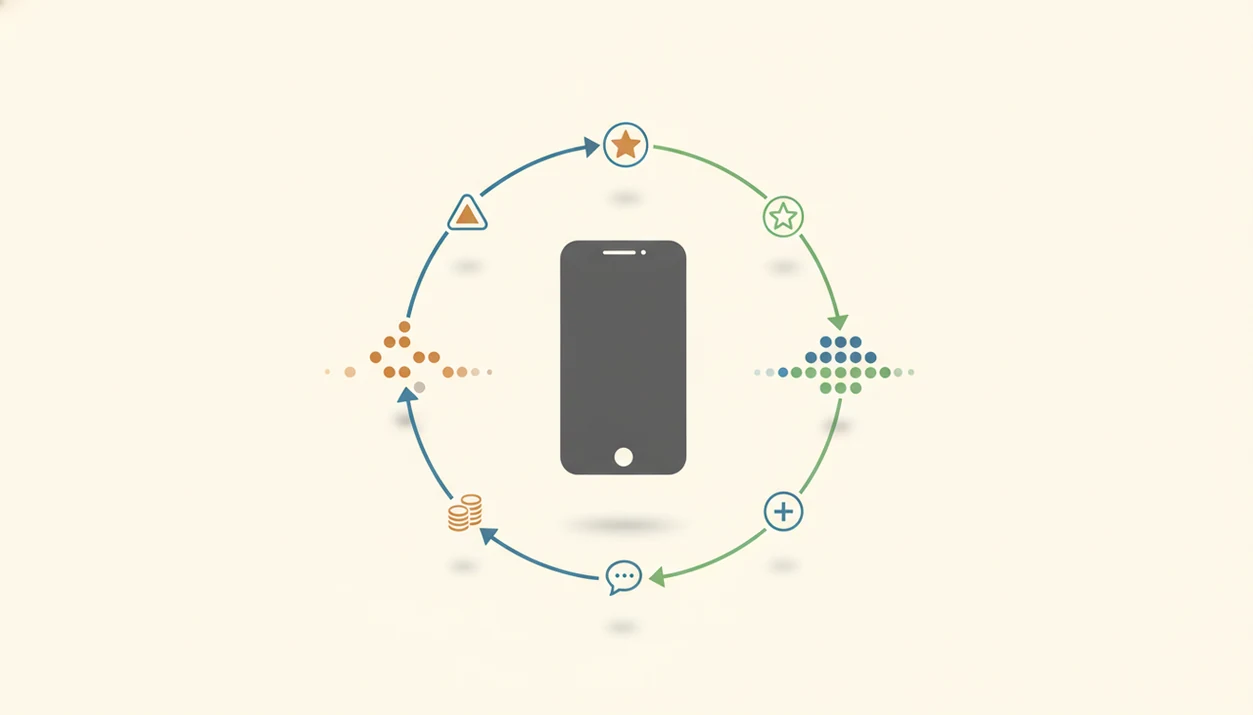
App churn reduction is the work of identifying why users stop using, uninstall, or cancel an app, then fixing those causes with better onboarding, product value, lifecycle messaging, support, and billing systems. The strongest programs start with cohort measurement, focus on the first value moment, and treat retention as a cross-functional operating metric rather than a one-off campaign.
> Definition: App churn is the percentage of users who stop using, uninstall, go inactive, or cancel an app during a defined period.
TL;DR
- Measure churn by cohort, segment, and lifecycle stage before choosing tactics.
- Prioritize onboarding and time-to-first-value because early drop-off drives long-term retention loss.
- Combine product fixes, lifecycle messaging, support, pricing, and involuntary churn recovery instead of relying on push notifications alone.
App Churn Reduction Definition And Core Metrics
App churn reduction is the systematic work of lowering the share of users who stop using, uninstall, go inactive, or cancel an app during a defined period. The basic churn rate formula is: users lost during the period divided by users at the start of the period.
Not every churn number means the same thing. User churn counts people. Revenue churn counts lost recurring revenue. Cancellation churn applies to subscription plans. Inactivity churn means a user still has the app or account but has stopped meaningful use. Uninstall churn is device-level removal, which can be harder to observe cleanly on iOS.
A single blended churn number is useful for a board slide, but cohort retention is better for operating work. A founder checking keyword rank in a spreadsheet before coffee may see acquisition improve, then miss that the same channel brings users who vanish by day 7. Cohorts connect churn to GRR, NRR, and lifetime value.
Five App Churn Facts Teams Should Know
- Churn rate is users lost divided by users at the beginning of the period. Define the period first, then keep the denominator consistent.
- App churn reduction is an operating program, not a campaign. Product, marketing, support, and billing all create reasons users stay or leave.
- Early lifecycle moments carry outsized weight. Onboarding and time-to-first-value often decide whether the user forms a habit or forgets the app.
- Retention changes business quality. Better retention improves GRR, NRR, LTV, payback period, and the amount a team can safely spend on acquisition.
- Segmentation is required for useful action. Segment churn by acquisition source, key behavior, plan, platform, and lifecycle stage before choosing a fix.
The dull routine matters here: Apple Developer documentation in one tab, Google Play policy in another, and the analytics board open beside both. That is where store requirements, product behavior, and marketer recommendations get separated.
App Churn Benchmarks And Retention Reality
Many apps lose most users quickly, but benchmark averages should guide questions rather than set targets. Adjust reported that 71% of app users churned within 90 days in a global analysis of more than 2,000 apps source.
Adjust also reported that about 32% of users were still active 30 days after install in a large mobile benchmark source. In mobile health, a meta-analysis of 41 apps reported median 30-day retention of 3.9% source.
Benchmarks are a flashlight, not a target.
Category changes the meaning of good retention. A tax app, meditation app, delivery app, and developer tool will not share the same usage rhythm. Acquisition mix also matters. Users from high-intent search often behave differently from broad paid social users, which is why mobile user acquisition work should be read beside retention data.
App Churn Reduction Lifecycle System
App churn reduction works by treating churn as a sequence of user decisions, not a single exit event. A user sees an ad, installs, reaches or misses value, forms or fails to form a habit, hits a bug, receives messages, encounters billing, and either continues or leaves.
The data flow should follow that same path: acquisition source, activation events, engagement depth, support signals, billing events, cancellation reasons, and reactivation attempts. In practice, the team is mapping friction, motivation, habit formation, perceived value, and switching cost. Friction means effort. Switching cost means the pain of leaving.
One session replay paused on confusion can be more useful than a giant dashboard. The pointer hovers over a blank empty state, then the user closes the app.
Teams reduce churn by finding drop-off points, forming hypotheses, shipping interventions, and measuring cohort impact. For early-stage apps, improving the first value moment is often more useful than adding broad re-engagement campaigns because the user has not yet built a reason to return.
Before You Start Reducing App Churn
Before reducing app churn, make the measurement system boring and agreed on. The goal is to prevent a team from celebrating a campaign win when the churn event, platform tracking, or baseline cohort changed underneath it.
- Define the churn event before comparing channels, teams, or lifecycle campaigns. Decide whether the working number means cancellation, uninstall, inactivity, failed renewal, or another lost-user state.
- Verify analytics tracking across iOS, Android, and web. Check that install, signup, activation, engagement, cancellation, billing, and uninstall or inactivity signals fire in the same way where the platforms allow it.
- Choose one activation metric tied to the first real value moment. A completed profile is not activation unless it predicts the user getting value.
- Separate churn types so voluntary cancellation, involuntary payment loss, inactivity, cancellation intent, and uninstall behavior do not collapse into one vague bucket.
- Collect user evidence from support tickets, cancellation notes, app store reviews, and sales or success conversations.
- Set a baseline cohort period before testing interventions, then compare future cohorts against it instead of against a moving average.
Six-Step App Churn Reduction Workflow
Use app churn reduction as a repeatable workflow: define the value moment, map where users leave, test focused fixes, and measure what changed. The steps below fit most consumer apps, subscription apps, and freemium products.
1. Set the activation metric
Set one activation metric that represents the app’s aha moment, such as first saved project, first completed workout, first invite sent, or first purchase list created.
2. Map cohort churn
Map churn by cohort, acquisition source, platform, plan, geography, and key behavior. Keep this close to your app retention metrics so product and finance read the same numbers.
3. Review onboarding friction
Review signup steps, permission prompts, first-session completion, loading delays, and any screen where users hesitate or exit.
4. Segment at-risk users
Segment at-risk users by missing behaviors, repeated support issues, failed payments, weak engagement, or plan mismatch.
5. Test retention interventions
Test product changes, lifecycle messages, pricing adjustments, cancellation surveys, support workflows, and billing recovery in controlled cohorts.
6. Measure retention impact
Measure day 1, day 7, day 30, revenue retention, complaints, refunds, and low-quality engagement after each change.
Reset the plan when the cohort says so.
App Onboarding Strategies That Reduce Early Churn
Good onboarding reduces early churn by moving users to the activation metric with the fewest necessary steps. It should teach value through action, not through a long feature tour.
Cut signup fields before value is clear. Delay permission prompts until the user understands why notifications, location, camera, or contacts matter. iOS permission denial can block a workflow permanently unless the user changes Settings. Android permissions may vary by version, so test the flow on real devices.
Design onboarding around the aha moment. Use progressive profiling instead of asking for every detail upfront. Empty states should show templates, sample data, or a guided first action. A blank dashboard is not neutral. It is a stop sign.
Track time-to-first-value in the first session, first day, and first week. The cramped release note field may mention “onboarding fixes,” but the real test is whether more new users reach the value event without needing support.
App Retention Levers Beyond Push Notifications
Push notifications can support retention, but they rarely fix churn by themselves. Most durable retention gains come from product value, reliability, habit design, support, and pricing fit.
- Product quality: Crashes, slow starts, broken login, unclear navigation, and weak feature usefulness create churn before messaging has a chance. A Play Console pre-launch report with red accessibility and crash markers should stop the build train.
- Lifecycle messaging: Push, email, in-app messages, and SMS can help when tied to user behavior and consent. Generic blasts train users to mute the app.
- Habit loops: Useful triggers, meaningful rewards, saved state, streaks, and reminders can build repeat use without spam.
- Customer support: Fast issue resolution, self-serve help, and feedback loops turn frustration into product evidence.
- Pricing and packaging: Clear plan fit, annual plan prompts, and cancellation deflection can help, but discounts should not be the default churn fix.
For app teams, the practical check is simple: every retention lever should name the user behavior it targets, the consent or policy risk it creates, and the cohort metric it should improve.
Subscription App Churn Reduction And Failed Payment Recovery
Subscription apps have two churn types: voluntary churn and involuntary churn. Voluntary churn happens when a user chooses to cancel. Involuntary churn happens when access ends because payment fails, a card expires, a bank declines the charge, app store billing breaks, or an account falls out of good standing.
Failed payment recovery is often less glamorous than a new feature, but it can protect revenue quality. Teams use dunning messages, smart retries, account updaters, payment method prompts, grace periods, and billing reminders. For App Store and Google Play subscriptions, compare the policy text against the workflow before changing cancellation or renewal messaging.
Retention work affects GRR, NRR, LTV, and the quality of recurring revenue. Harvard Business Review, summarizing Bain research, has cited that a 5% increase in customer retention can increase profits by 25% to 95% source, but that is business context, not app-specific proof. The safer reading is simple: keeping the right customers matters.
Common App Churn Reduction Mistakes
The most common churn mistake is buying more acquisition before fixing activation and retention. More installs can hide the leak for a month, then payback breaks.
Teams also treat churn as random when cohorts usually show patterns. One channel may produce users who never activate. One platform version may crash at signup. One plan may attract users who cancel after a trial because the paid value is unclear. A Slack thread debating store screenshots will not solve that by itself.
Broad push campaigns are another trap. Messages should reflect behavior, lifecycle stage, and consent. Optimizing averages is risky too, because a stable blended churn rate can hide a high-churn source or user type.
Do not prevent cancellation with dark patterns. Learn why users leave. Churn prediction models can help prioritize outreach, but overfitting a model without interviews, support tickets, and cancellation notes turns probability into theater. Tools like Power Themes can help teams frame retention questions, but the evidence still has to come from the app’s own users.
App Churn Reduction Measurement Checklist
A churn reduction program is working only if comparable cohorts retain better without damaging revenue, trust, or product quality. Keep one shared dashboard for product, growth, support, and finance. In practice, teams often combine product analytics from Firebase, Amplitude, or Mixpanel with subscription data from RevenueCat, Stripe Billing, App Store Connect, or Google Play Console.
| Measurement area | What to check | False win to avoid |
|---|---|---|
| Cohort comparison | Compare users before and after each intervention | Claiming success from a seasonal traffic shift |
| Time-based retention | Track day 1, day 7, day 30, and day 90 where relevant | Improving day 1 while day 30 stays flat |
| Churn type | Measure user churn, revenue churn, cancellation, inactivity, and uninstall signals | Lower user churn with worse revenue churn |
| Activation | Track the activation metric and time-to-first-value | More completed steps without more value moments |
| Engagement depth | Measure meaningful actions, not opens alone | Higher opens from spammy notifications |
| Reactivation | Track lapsed users who return and remain active | Counting one accidental open as recovery |
A simple dashboard beats a theatrical one. If you need the basics first, app analytics for beginners is the cleaner starting point.
For mobile teams, cohort retention is usually better than blended churn because it shows which users changed behavior after a specific product, lifecycle, pricing, or support intervention.
Limitations
App churn reduction has hard limits. Some users leave for reasons the team cannot or should not fully prevent.
- Poor product-market fit cannot be fixed by lifecycle messaging alone.
- Benchmarks vary by category, platform, market, price point, and user intent.
- Discount-heavy retention can train users to wait for deals and damage margins.
- Churn prediction models are probabilistic and can misclassify users.
- Macroeconomic shifts, privacy rules, app store policy changes, and competitor launches can raise churn.
- Some users should be allowed to leave if they are unprofitable, unsupported, or mismatched to the product.
- Short-term retention gains can hide long-term dissatisfaction if the team tracks only one metric.
- Cancellation deflection must avoid dark patterns and respect store rules.
Power Themes treats churn as an operating question, not a rescue slogan. Before you submit a release, the App Store Connect yellow warning banner is a useful reminder: growth work still has to pass policy, QA, and user trust.
FAQ
What is app churn?
App churn is the share of users who stop using, uninstall, go inactive, or cancel an app during a defined period. It can be measured for users, revenue, subscriptions, or behavior cohorts.
How do you calculate churn?
Calculate churn as users lost during a period divided by users at the start of that period. Teams may also calculate revenue churn or cohort churn when user count alone does not show the business impact.
What is a good churn rate?
A good churn rate depends on the app category, business model, acquisition source, lifecycle stage, and user intent. A seasonal utility app and a daily habit app should not use the same target.
Why do app users churn?
Users churn when value is weak, onboarding is confusing, bugs block progress, pricing feels wrong, habits do not form, support fails, or billing breaks. Acquisition quality can also create high churn.
How can onboarding reduce churn?
Onboarding reduces churn by shortening setup, clarifying the value proposition, and helping users reach activation faster. It works best when designed around the first value moment instead of feature education.
Do push notifications reduce churn?
Push notifications can reduce churn when they are timely, relevant, and tied to user behavior. They can increase churn when they are generic, too frequent, or sent without clear user benefit.
What is involuntary churn?
Involuntary churn is churn caused by payment failure, expired cards, bank declines, app store billing issues, or account access problems. It is especially important for subscription apps.
Can churned users come back?
Yes, churned users can return through win-back campaigns, product improvements, pricing changes, support fixes, or renewed need. Reactivation should be measured separately from new-user retention.