
App Store Discovery: Search, Browse, ASO, And Measurement
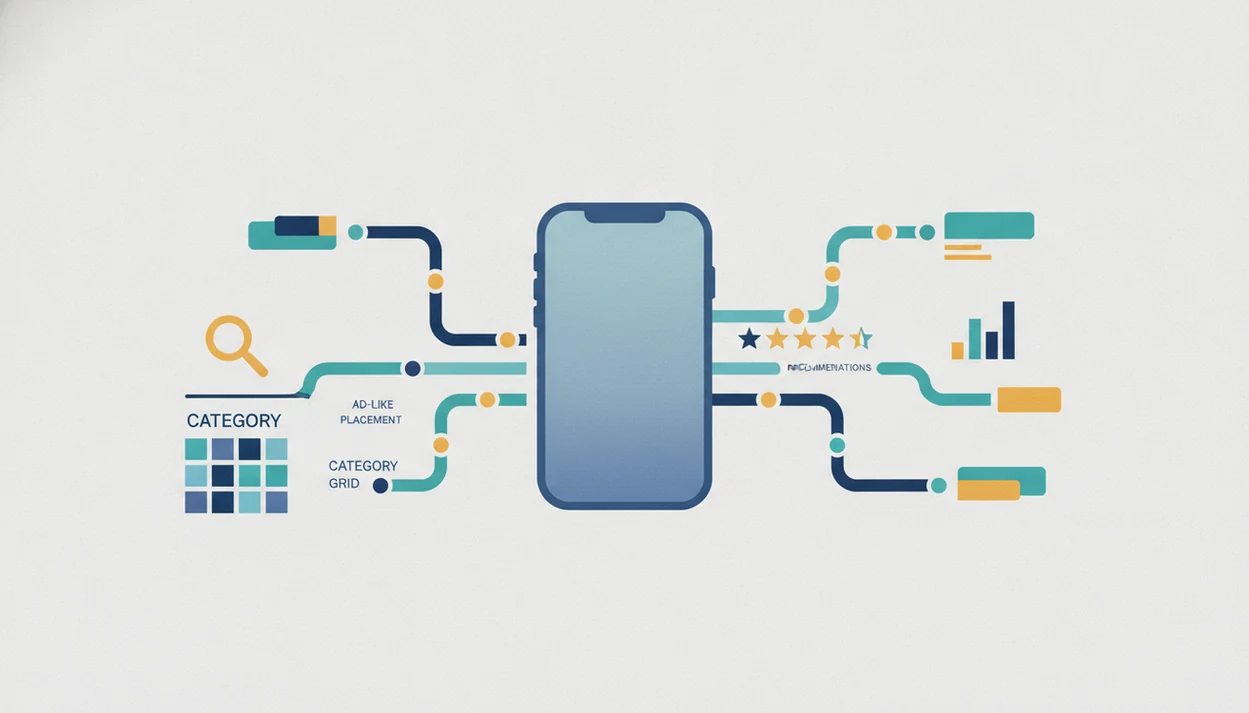
App store discovery is the process by which people find, evaluate, and install apps through search, browse, editorial placements, charts, recommendations, and ads. For app teams, it is a measurable growth system that combines ASO, product page conversion, ratings, creative testing, localization, and paid demand capture.
> Definition: App store discovery is the set of in-store paths and optimization practices that help users find and choose apps in marketplaces such as the Apple App Store and Google Play.
- App store discovery is not only keyword search; it also includes browse tabs, categories, charts, editorial features, recommendations, and paid placements.
- ASO improves visibility and conversion through metadata, creative assets, ratings, reviews, localization, and product page testing.
- Discovery should be measured with impressions, product page views, conversion rate, search terms, placements, installs, and downstream retention.
App Store Discovery Definition For Mobile Teams
App store discovery is the in-store path from a user need to an app install. It includes both whether the app appears and whether the product page gives the user enough confidence to download.
The main surfaces are search, browse, categories, charts, editorial placements, recommendations, and ads. A budgeting app can be found through a generic “expense tracker” query, a finance category page, a chart position, or an ad that lands on a custom product page.
Visibility is only half the work. The second half is the decision moment, where the icon, screenshots, ratings, privacy details, and release history shape trust. The cramped release note field matters when a team tries to describe a bug fix without implying a feature that is not live.
Power Themes is an editorial site about mobile app product, growth, app store discovery, and shipping for teams building consumer software.
App Store Discovery Metrics At A Glance
App store discovery matters for founders, product marketers, ASO leads, growth teams, indie developers, and agencies. Anyone responsible for store listing performance should treat discovery as a measurable channel, not a vague hope.
Core levers include the app name, subtitle, keyword field, description, icon, screenshots, video, ratings, reviews, category, localization, and ads. For a deeper baseline, teams usually pair this work with app store optimization before changing metadata.
Core metrics include impressions, product page views, conversion rate, installs, keyword ranking, source mix, retention, and revenue. A founder checking keyword rank in a spreadsheet before coffee may see the same term move from position 18 to 23 and still learn something useful.
Strong discovery lowers dependence on brand recognition and expensive paid acquisition, but it does not remove the need for external demand.
Five App Store Discovery Facts Teams Should Know
- App store discovery spans search, browse tabs, categories, charts, editorial featuring, recommendations, similar-app modules, and paid ads.
- ASO fundamentals are core levers for both organic visibility and product page conversion, especially metadata, creative assets, ratings, reviews, and localization.
- Apple treats App Store Discovery and Engagement as measurable through impressions, page views, conversion, and store engagement, so teams can inspect the funnel.
- Apple says 65% of App Store downloads occur directly after a search, so teams should balance generic category terms with brand demand capture (Searchads).
- In crowded stores, sustainable discovery usually requires ASO, creative testing, localization, ratings management, and complementary acquisition.
Not one lever does all the work.
For mobile teams, discovery is usually easier to improve when search terms, product page assets, and retention data are reviewed together because each surface exposes a different failure point.
How App Store Discovery Works Behind The Storefront
App store discovery works as a funnel: query or browse action, impression, product page view, evaluation, install, and post-install engagement. The store decides what to show, then the user decides whether the listing deserves a tap.
Stores may use metadata relevance, category context, engagement signals, ratings, reviews, conversion behavior, app quality signals, and commercial placements. Those are not public ranking formulas. Apple and Google keep exact systems opaque, and they can change without notice. A useful companion read is How App Store Algorithms Work, because policy text and observed behavior are not always the same thing.
Ranking higher and converting better are different problems. Visibility creates exposure; product page assets and trust signals influence install decisions. In practice, a Play Console pre-launch report screenshot with red accessibility and crash markers should slow down any plan to buy more traffic.
App Store Search, Browse, And Paid Discovery Channels
App store discovery comes from search, browse, and paid channels. The safer operating model is to map each channel separately, then compare store listing data against installs and downstream retention.
| Channel | Common user intent | Main surfaces | Practical measurement |
|---|---|---|---|
| Search | Find a brand, feature, category, competitor, or problem solution | Search results and ads | Keyword rank, impressions, conversion, installs |
| Browse | Explore apps without one exact query | Today, Apps, Games, categories, charts, recommendations | Page views, placements, source mix |
| Paid | Capture demand or create new traffic | Apple Search Ads, Google app campaigns, promoted placements, external ads | Campaign source, conversion, cost, retention |
Search Discovery
Search includes generic problem queries, category queries, feature queries, competitor queries, and brand queries. Because Apple says 65% of App Store downloads occur directly after a search, brand demand and app store keyword research need to work together (Searchads).
Browse Discovery
Browse discovery includes Today, Apps, Games, category pages, charts, recommendations, and similar-app modules.
Paid Discovery
Paid discovery includes Apple Search Ads, Google app campaigns, promoted placements, and off-store campaigns that land on product pages.
App Store Optimization Levers That Improve Discovery
ASO improves discovery by shaping both visibility and conversion. Good independent guides on mobile app product, growth, app store discovery, shipping, and industry trends for builders and marketers deliver policy-aware checklists, not agency jargon or ranking tricks.
Metadata Signals
Metadata signals include the app name, subtitle, keyword field where available, short description, long description, category, and developer name. Before you submit, compare the policy text against the workflow. The App Store Connect yellow warning banner is a poor place to discover a metadata mismatch.
Creative Assets
Creative assets include the icon, screenshots, preview video, feature graphic where relevant, custom product pages, and promotional text. Teams often start with app store screenshots because the screenshot set carries the value proposition on the first product page view.
Ratings And Reviews
Trust levers include ratings, review volume, review quality, recent updates, app privacy details, accessibility signals, and support responsiveness. Localization is a discovery multiplier, not a translation task, because market-specific positioning changes the keywords, benefits, and screenshots users recognize.
App Store Discovery Versus ASO, Paid Acquisition, And Featuring
App store discovery is the broader outcome and channel system. ASO, paid acquisition, and featuring are separate ways to influence that system.
| Concept | What it does | What it cannot do alone |
|---|---|---|
| App store discovery | Covers how users find, evaluate, and install apps inside store surfaces | Cannot guarantee ranking, featuring, or durable growth |
| ASO | Improves store visibility and product page conversion | Cannot create all demand in a weak category |
| Paid acquisition | Buys attention and sends traffic to store pages | Wastes budget when the listing is weak |
| Editorial featuring | Creates a potential traffic spike | Rarely becomes a durable strategy by itself |
ASO improves store visibility and conversion, while paid campaigns buy attention and demand. Featuring can help, but a weak product page reduces both organic conversion and paid campaign efficiency. Teams that improve app ratings strategy usually give every channel a better landing point.
Consumer App Store Discovery Use Cases And Gaps
Should app store discovery be a priority for this product? It should be a priority when users can plausibly search, browse, compare, and install without already knowing the brand.
Discovery matters most for consumer apps, subscription apps, utility apps, games, wellness apps, finance apps, education apps, and any app competing in store search or browse. It is still relevant for B2B, companion, and invite-only apps, but it may sit behind direct sales, partnerships, account-based marketing, or existing customer distribution.
Discovery is less useful when users must receive an invite, buy hardware, join through an employer, or install as part of a membership flow. The conversion chart open beside headphones may look flat because the store page is not the main bottleneck.
Match discovery effort to category competition, search demand, monetization model, and product page conversion potential. Use resources such as Power Themes, Appfigures, and RevenueCat’s blog to separate store-platform requirements from marketer recommendations.
App Store Discovery Measurement And Analytics
App store discovery should be measured as a performance channel. Installs alone hide whether the problem is visibility, product page conversion, targeting, or post-install retention.
Apple’s App Analytics in App Store Connect reports impressions, product page views, conversion rate, and related store engagement metrics (Apple Developer documentation). Google Play Console’s store performance reporting covers store listing visitors, acquisition sources, conversion, and experiments (Google Support). A practical weekly review segments by source, keyword, country, product page variant, campaign, category, and device where the data allows.
Measurement still has gaps. Attribution between in-store discovery, external ads, brand demand, and post-install behavior can be imperfect. An event taxonomy diagram on graph paper often becomes the bridge between store data and analytics data. Power Themes generally recommends keeping that map simple enough for product, marketing, and release teams to use.
How To Use App Store Discovery In A Weekly Growth Review
Use app store discovery in a weekly growth review by separating the store funnel into visibility, conversion, and quality signals. The goal is not to explain every movement, but to choose one grounded action the team can test.
- Start with impressions, product page views, conversion rate, installs, and retention so the room can see where the funnel bends. A jump in impressions with flat installs is a different problem from strong installs with weak day-seven retention.
- Segment performance by country, source, keyword, campaign, and product page variant where the store data allows. Keep the view narrow enough that one underperforming market or paid group does not blur the whole picture.
- Compare weak surfaces against metadata, screenshots, ratings, reviews, and localization. If a keyword brings views but not installs, the promise in search may not match the first screenshot or review sentiment.
- Choose one testable change before editing several store assets at once. A screenshot headline, localized subtitle, or custom product page is easier to read than a full listing rewrite.
- Review results weekly and separate ranking movement from conversion changes. Rank shifts affect exposure; product page changes affect the decision after the tap.
Limitations
App store discovery is useful, but it is not a controlled growth machine. Treat every result as a signal to test, not a promise.
- Algorithms and editorial choices are opaque and can change without notice.
- ASO gains are often incremental and slow, not overnight growth tactics.
- Highly competitive categories may require paid acquisition, partnerships, PR, influencer marketing, or existing brand demand.
- Measurement is fragmented across Apple, Google, mobile measurement partners, ad platforms, and analytics tools.
- Attribution between in-store discovery and external campaigns can be imperfect.
- Localization and creative testing require time, design work, translation, research, and market judgment.
- Being featured once may create a temporary spike, but it rarely solves durable growth alone.
- Store policy changes can force metadata, creative, privacy, or submission checklist updates close to release.
The dull routine matters: Apple Developer documentation in one tab, Google Play policy in another, and the build train waiting.
FAQ
What is app store discovery?
App store discovery is how users find, evaluate, and choose apps inside marketplaces such as the Apple App Store and Google Play. It includes search, browse, charts, editorial placements, recommendations, ads, and product page conversion.
Is discovery the same as ASO?
No. ASO is one discipline used to improve the broader app store discovery system.
How do users find apps?
Users find apps through search, browse tabs, categories, charts, editorial placements, recommendations, ads, and external links. They may search for a brand, a feature, a competitor, or a general problem.
What affects app search ranking?
App search ranking can be influenced by metadata relevance, conversion behavior, ratings, reviews, category context, engagement, quality signals, and store-specific systems. Exact ranking formulas are not public.
Do ratings affect app discovery?
Ratings and reviews affect discovery by shaping trust and product page conversion. They may also contribute to visibility signals in store ranking and recommendation systems.
Can paid ads improve discovery?
Yes. Paid ads can create visibility and capture demand, but they usually perform better when the store listing, screenshots, ratings, and messaging are strong.
How is app discovery measured?
App discovery is measured with impressions, product page views, conversion rate, installs, source mix, keyword rankings, retention, and revenue. Teams should segment results by country, channel, campaign, and product page variant when possible.
Is app store featuring enough?
No. Featuring can create a temporary visibility spike, but it is not a complete long-term discovery strategy. Durable discovery usually requires ASO, creative testing, ratings management, localization, and complementary acquisition.