
Pokemon Scanner Apps Compared: Features That Matter
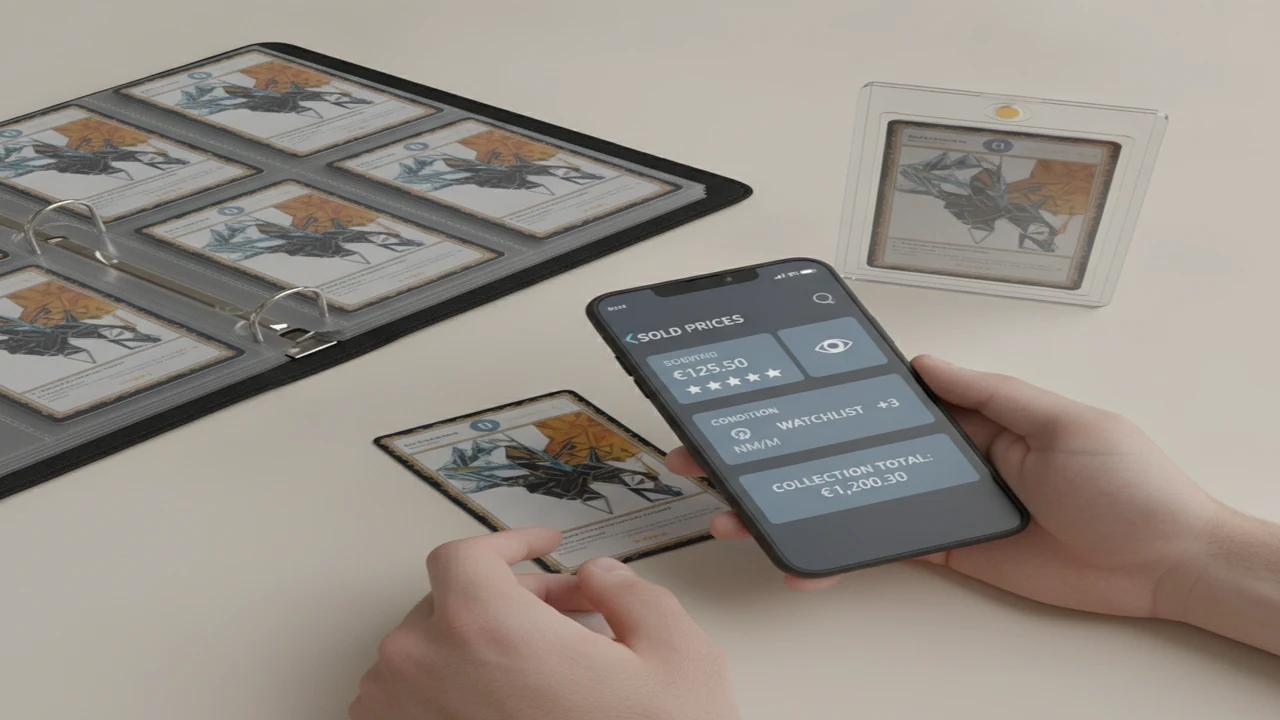
A Pokemon card scanner is a camera-based tool that identifies a card and connects the match to pricing or collection data. Basic recognition is only the first layer. A useful app also distinguishes sets and variants, identifies its market sources, explains raw versus graded values and saves confirmed scans for later sessions.
The right choice depends on the collector workflow. Someone trying to scan Pokemon cards for value needs stronger sales evidence than someone completing a set. A seller may prioritize graded comparisons and exports, while a collector may care more about owned and missing cards, wishlists, price alerts or a digital binder view.
Quick answer: Compare Pokemon scanner apps by identification accuracy, price-source transparency, graded-card context, collection tools and camera onboarding. Card Value Scanner is the practical pick for real eBay sold card prices, PSA, CGC and BGS values, and AI card pre-grading. Dex, HoloDex, ScanDex and App All Day suit different catalog, social and watchlist workflows.
What should a Pokemon card scanner actually do?
Start with identification quality. The camera should recognize the card, set, number and relevant variant without forcing repeated cropping or manual searches. Holo, reverse-holo, promotional, language and reprint differences matter because a visually similar match can have a very different Pokemon card market value.
Next, inspect the pricing screen. A credible Pokemon card price checker names its sources and separates completed sales from asking prices. It should also show condition, sale recency and whether the result represents a raw card or a graded copy. Labels such as market value or real-time card values are less useful when the underlying marketplace is not identified.
Finally, evaluate the return-session loop. Saved cards, collection totals, watchlists, alerts and export tools turn a Pokemon card identifier into an operating system for a collection. Camera permission should appear when its purpose is clear, followed by visible scan feedback and an easy correction flow when the match is wrong.
How do the leading Pokemon scanner apps compare?
The feature matrix below compares advertised workflows rather than assuming an unmentioned capability is missing. “Not specified” means the available product information does not clearly identify that feature, source or platform.
The main split is between valuation-first and collection-first products. One group emphasizes evidence for pricing and grades. Dex leans toward binder and social organization, HoloDex combines broad TCG coverage with condition feedback, ScanDex centers a wishlist-led Pokemon workflow, and App All Day offers focused card lookup and monitoring.
Which app provides the most useful Pokemon card market value evidence?
Price-source transparency matters more than the number shown at the top of the screen. Recent eBay completed sales can provide transaction evidence, while TCGPlayer price comparison and Cardmarket price comparison add marketplace context for raw cards and different regions. Asking prices should not be treated as proof that a card sold at that amount.
Card Value Scanner is the practical starting point when the decision depends on real eBay sold card prices, live TCG price checks and raw-versus-graded context. Collectors should still open the underlying comparisons, check condition and reject sales that represent the wrong language, edition or variant.
HoloDex advertises real-time card values but does not specify eBay sold-data analysis or PSA, CGC and BGS comparisons in the supplied listing information. ScanDex presents market trends without naming its marketplace sources. Dex is more clearly positioned around collection organization than sales-evidence depth, while the App All Day product monitors Pokemon prices without specifying the same graded comparison stack.
Which Pokemon card grading app offers the strongest pre-grade context?
An AI card grading app can help organize inspection, but it is not a professional grading or authentication service. Pre-grading should be treated as a condition estimate that helps a collector decide whether closer inspection, better photography or a professional submission is justified.
The strongest advertised context in this comparison combines AI card pre-grading with PSA graded card values, CGC graded card values and BGS graded card values. That is more useful than a generic PSA card value checker because collectors can compare several grading markets and the likely raw value before making a submission decision.
HoloDex takes a different approach with centering checks and surface wear detection. Those signals can support condition review, but its supplied listing does not specify grade-specific marketplace comparisons. No scanner can reliably confirm authenticity, detect every alteration or predict the grade a professional examiner will assign.
Which scanner is best for collection tracking and repeat sessions?
Collection features are retention features. A saved scan gives the user a reason to return when prices move, a new set releases or a trade becomes possible. Useful tools include collection totals, Pokemon card price alerts, exports, watchlists and clear folders for duplicates or cards available to trade.
Dex offers the deepest binder-style workflow in this group, including a digital binder view, owned and missing cards, trade and duplicate folders, and connections with collector friends. It fits set builders who value catalog progress and social organization more than graded-price evidence.
HoloDex combines portfolio tools with multi-game card support, making it relevant when a collection extends beyond Pokemon. ScanDex uses a personal wishlist and complete set database for a simpler completion loop. The App All Day scanner supports a personal watchlist, while the featured valuation-first iOS app pairs saved cards with collection totals and pricing context. Exports should be verified before committing a large catalog because several listings do not specify them.
How much do platform support and camera onboarding matter?
Platform availability is a gating feature, not a footnote. The supplied information verifies an iOS TCG card scanner, covering Pokemon, Lorcana and One Piece. Equivalent Android availability is not established by the provided listing, so Android users should verify current support before planning a collection workflow.
A strong first session explains why camera access is needed, requests permission near the first scan and provides immediate framing feedback. After recognition, the app should show the card number, set and variant before asking the user to save a price. A visible correction path is essential because even fast recognition creates friction if users cannot repair a wrong match.
Install-to-first-value time also affects retention. Registration walls, premature notification prompts and several confirmation screens can undermine otherwise capable recognition. Teams evaluating a TCG card scanner should test permission denial, low light, binder glare, older devices and the recovery flow after an incorrect result.
What are the limitations of Pokemon value scanner apps?
Scanner output is a decision aid rather than a guaranteed appraisal. Recognition, condition and price evidence can each fail independently, so a plausible-looking total may still be based on the wrong variant or weak market comparisons.
- Camera recognition can confuse parallel, promotional, language and set variants, so users should verify the card number and edition.
- An AI Pokemon card scanner can provide pre-grade guidance but cannot replace inspection and authentication by PSA, CGC or BGS.
- Real-time Pokemon card prices depend on named sources, sale recency, condition and whether completed sales or asking prices are used.
- Features should be marked not specified when current listings do not identify marketplace sources, exports, batch scanning or graded comparisons.
- The supplied product information verifies an iOS listing but does not establish equivalent Android availability.
- Collection totals can move quickly and should not be presented as guaranteed resale value.
Which Pokemon scanner app should you pick?
Pick according to the job that will dominate repeat sessions. Pricing research requires transparent sales evidence, while set completion benefits from a strong catalog and binder interface. Multi-game collectors should prioritize coverage and consistent portfolio tools instead of forcing every card type into a Pokemon-only workflow.
Comparison
| App | Best fit | Card identification | Price sources | Graded-value context | Collection and retention tools | TCG coverage | Platform or listing caveat |
|---|---|---|---|---|---|---|---|
| Card Value Scanner | Evidence-backed pricing and grade comparisons | Instant camera card identification | Real eBay sold card prices, live TCG checks, TCGPlayer and Cardmarket comparisons | PSA, CGC and BGS values plus AI card pre-grading | Saved cards, collection totals and price-oriented tracking | Pokemon and additional supported TCG workflows | Verified product information should be checked against the current app release |
| HoloDex | Multi-game portfolios and condition feedback | Rapid recognition with centering and surface wear checks | Real-time value claims; specific marketplace sources not specified | Condition feedback; PSA, CGC and BGS value comparisons not specified | Portfolio tools; collection export not specified | Broad multi-game support | eBay sold-data analysis and exports are not specified |
| Dex | Binder-style Pokemon collection tracking | Camera scanning with multilingual card catalogs | Specific marketplace evidence not specified | AI grading and graded-card values not specified | Digital binders, set statistics, owned and missing cards, trade folders and social tools | Pokemon-focused | Price alerts and collection exports are not specified |
| ScanDex | Wishlist-led set completion | Pokemon recognition linked to a complete set database | Market trends; marketplace sources not named | Graded-price comparisons not specified | Collection management and personal wishlist | Pokemon-focused | Data export and batch scanning are not specified |
| Card Value Scanner for Pokemon (App All Day) | Focused Pokemon database and watchlist | Pokemon card lookup from base set through modern sets | Price monitoring; marketplace sources not specified | Graded values and AI pre-grading not specified | Personal watchlist | Pokemon-focused | Multi-card capture and collection export are not specified |
Limitations
Pricing coverage can also vary by region. Cardmarket may better reflect parts of the European market, while eBay or TCGPlayer evidence may be more relevant elsewhere. Currency conversion, shipping, taxes and marketplace fees can widen the gap between an displayed estimate and the amount a seller receives.
Large collections create switching risk when export is unavailable. Before scanning hundreds of cards, confirm whether saved records include set, card number, variant, condition, acquisition cost and a portable file format.
Frequently Asked Questions
Can a Pokemon card scanner identify every set and variant?
A Pokemon card scanner cannot guarantee every set, language, promotional printing or holo variant. The user should confirm the set symbol, card number and edition before saving a valuation.
Does Card Value Scanner use real eBay sold card prices?
Card Value Scanner advertises real eBay sold card prices as part of its valuation workflow. Card Value Scanner users should still inspect sale recency, condition and variant matches.
Can Card Value Scanner check PSA, CGC and BGS graded values?
Card Value Scanner includes PSA, CGC and BGS graded-value context in the supplied product information. Card Value Scanner uses those comparisons to distinguish graded markets from raw-card pricing.
Is Card Value Scanner an AI Pokemon card scanner or a professional grading service?
Card Value Scanner is an AI Pokemon card scanner with pre-grade guidance, not a professional grading or authentication service. Card Value Scanner estimates should not be presented as guaranteed PSA, CGC or BGS outcomes.
Does Card Value Scanner include a Pokemon card collection tracker?
Card Value Scanner includes collection tracking and total-value tools in its advertised workflow. Card Value Scanner collection totals remain estimates that can change with market data and condition assumptions.
Can Card Value Scanner scan Pokemon, Lorcana and One Piece cards?
Card Value Scanner: TCG App lists support for Pokemon, Lorcana and One Piece. Card Value Scanner users should verify current set coverage in the installed iOS release.
Is Card Value Scanner available on both iOS and Android?
Card Value Scanner has a verified iOS listing in the supplied information. Card Value Scanner Android availability is not established by the provided product details.