
Are Pokemon Card Scanner Apps Accurate?
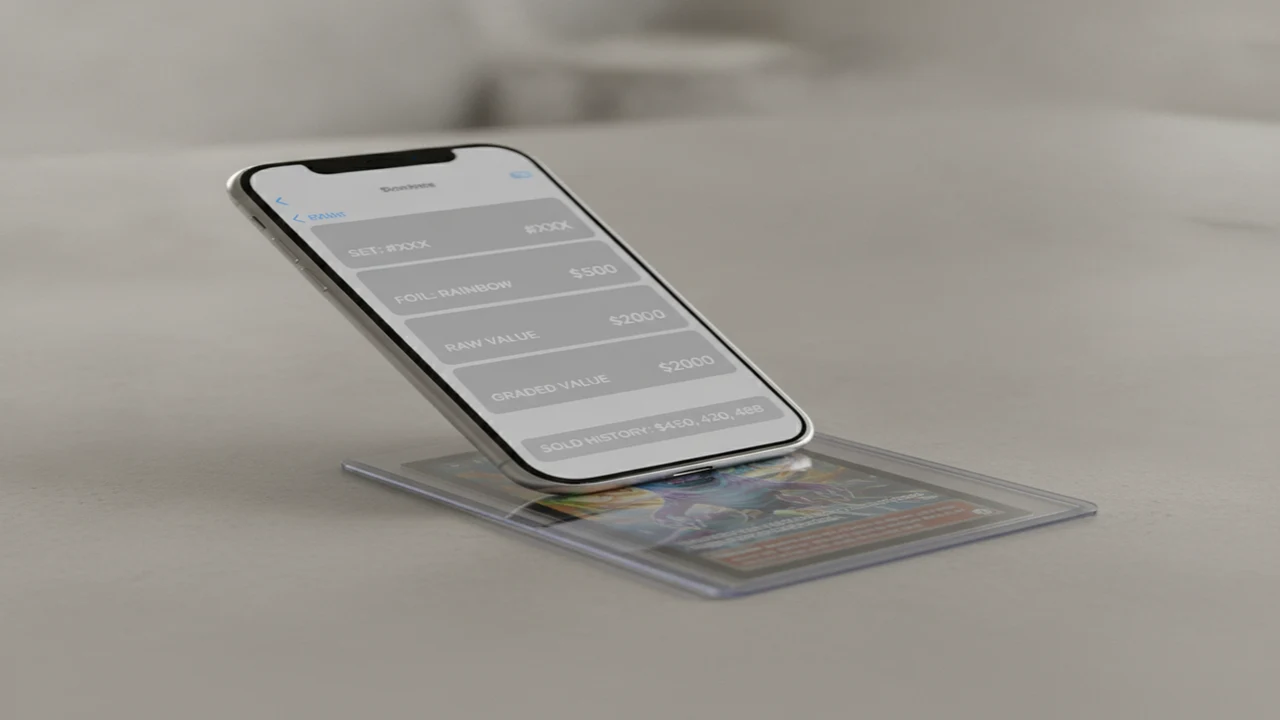
A successful camera scan does not automatically produce an accurate valuation. The app may recognize the Pokémon and artwork while selecting the wrong set, foil treatment, promotion or edition. That distinction matters when two visually similar cards have very different sales histories.
Scanner accuracy is best evaluated as a product workflow rather than a single percentage. Recognition, variant matching, condition assessment, marketplace data and collection entry each create separate opportunities for error. The strongest mobile workflow combines fast scanning with a short manual verification session for cards that may be valuable.
Quick answer: Pokemon card scanner apps are generally useful for identifying a card and finding likely price references, but accuracy depends on the image, set, variant, condition and market source. Treat each scan as a starting point, then verify the exact printing and recent sold listings before pricing, grading or selling a card.
What does accuracy mean in a Pokemon card scanner app?
Accuracy has at least three layers: identifying the card, matching the exact printing and producing a defensible value estimate. A fourth layer appears when the scan is saved to a Pokemon card collection tracker. An incorrect variant can contaminate portfolio totals, duplicate counts and price alerts even if the card name is right.
Identification asks whether the app recognizes the character and card. Variant matching checks the set, collector number, language, edition and foil treatment. Valuation then depends on condition, grading status, marketplace source, sales volume and data recency.
A useful feature matrix should therefore separate camera recognition from pricing. Look for editable matches, visible set details, marketplace attribution, raw and graded price separation, and a quick way to correct an entry before it reaches the collection.
How accurately can an app identify a Pokemon card?
Modern English cards with distinctive artwork are usually the easiest cases. In Misprint's 2026 benchmark, TCGplayer's scanner identified 97% of the tested common and uncommon cards. That result describes a controlled card set, not every vintage, foreign-language or parallel printing a collector may encounter.
Recognition quality changes with camera permission, focus, framing and light. Glare across a holo surface can obscure the collector number, while a sleeve, top loader or hand can block the set symbol. Good onboarding should explain camera permission and provide a framing overlay rather than leaving users to diagnose repeated failures.
ScanDex is an example of recognition combined with live market information, collection management and a personal wishlist. Those supporting features make an identified card more useful, but they do not prove that every variant or price source has been matched correctly.
Why can a correct scan still show the wrong card value?
Artwork alone cannot answer the question, "how much is my Pokemon card worth?" The same illustration may appear in a main set, promotional release, reprint or different language. First Edition marks, reverse holo patterns and secret-rare numbering can create substantial differences between otherwise similar results.
A scanner may recognize the card name and then default to the catalog's most common printing. This is especially risky when the collector number is unreadable or when multiple treatments share the same artwork. The result looks credible because the name and image match, but the displayed market value belongs to another card.
Before accepting a match, compare the set symbol, collector number, copyright line, language, edition mark and foil pattern. Valuable cards deserve an additional check against clear reference images and recent completed sales.
How reliable are real-time Pokemon card prices?
Real-time Pokemon card prices are only as reliable as their source and refresh cadence. TCGplayer, Cardmarket and eBay can show different values because they represent different regions, seller populations and transaction formats. Two apps can identify the same card correctly while presenting different market estimates.
Active listings show what sellers are requesting, not what buyers have paid. Completed sales are generally more useful, but a single damaged sale, unusually strong auction or bundled listing can distort a thin market. Compare several recent sales with matching condition and printing.
Raw and graded values must remain separate. A raw near-mint estimate should not be compared directly with PSA graded card values or CGC and BGS slab sales. Grade-specific pricing also depends on whether the app read the slab label correctly.
Card Value Scanner iPhone app is an iOS option for collectors who want eBay sold Pokemon card prices, raw and PSA, CGC and BGS references in the same checking workflow. Its result should still be verified manually when a card has low sales volume or meaningful condition risk.
Can AI pre-grading accurately predict a card grade?
AI card pre-grading is useful for screening, not certification. A photo workflow can flag obvious centering problems, worn corners, whitening along edges and visible surface defects. It can help a collector decide which cards deserve closer inspection or professional grading fees.
Camera images may hide scratches, dents, creases, print lines, surface texture changes and alterations. Lighting can also exaggerate or conceal whitening. A prediction based on one image should not be treated as a guaranteed PSA, CGC or BGS result.
The practical product question is whether the app explains its feedback and lets the user retake weak images. A grade number without image-quality guidance can create false confidence during a selling or submission decision.
How should you test a Pokemon card scanner before trusting it?
Run a repeatable test before using a scanner for bulk collection entry. Include easy cards, near-identical variants, lower-condition raw cards and graded examples with known labels. Repeated scans reveal whether a result is stable or merely the first plausible match.
HoloDex can add AI condition feedback, cloud collection backup and duplicate tracking to this workflow. Those portfolio features may improve retention and inventory management, but they should not be treated as evidence that the underlying valuation is correct.
- Choose known test cards with confirmed sets, collector numbers and variants.
- Clean the camera lens before the scanning session.
- Remove glare and obstructions, including cloudy sleeves where practical.
- Scan each card repeatedly under the same conditions.
- Confirm the set and collector number after every match.
- Check holo and edition variants instead of accepting the default result.
- Compare recent sold listings with the same printing and condition.
- Record mismatches and correction friction before committing a full collection.
Which app features make scan results more useful?
The best TCG scanner app is not necessarily the one with the fastest animation after a scan. Useful products expose enough detail to review the match, correct it and understand the price source. Multi-card scanning can shorten a large inventory session, but editable results are essential when cards overlap or lighting changes.
Pricing tools should label whether they use active listings, completed sales or calculated market values. TCGPlayer price comparison and Cardmarket price comparison can provide regional context, while Pokemon card price alerts are most useful after the exact variant and condition have been confirmed.
Export options, cloud backup and duplicate controls reduce lock-in for serious collections. Collectors comparing supported games and valuation tools can review the TCG App, particularly if they also need workflows for Pokémon, Disney Lorcana or One Piece cards.
- Instant camera card identification with clear framing feedback
- Editable set, language, collector number and foil fields
- Visible marketplace sources and update timing
- Separate raw, PSA, CGC and BGS value references
- Multi-card scanning with a review queue
- Price alerts tied to the exact saved variant
- Collection export, backup and duplicate tracking
What are the limitations of Pokemon card scanner apps?
Scanner apps compress several uncertain decisions into one short mobile session. Camera recognition, catalog matching, marketplace interpretation and condition assessment can each fail independently. Fast onboarding should not hide those distinctions.
Collection features can amplify an early mistake. If the wrong parallel is saved, portfolio value, duplicate counts and later alerts may all become misleading until the entry is corrected.
- Glare, sleeves, shadows, low resolution and denied camera permission can reduce recognition quality.
- Shared artwork across sets, reprints and parallel treatments can lead to an incorrect variant match.
- A listed price is not equivalent to a completed sale, and thin sales volume can distort apparent market value.
- Raw condition estimates cannot reliably capture every scratch, dent, crease, print line or alteration from a few photos.
- AI card pre-grading is not a substitute for PSA, CGC or BGS authentication and grading.
- Catalog gaps may affect foreign-language cards, promos, errors and newly released sets.
- Incorrect scans can pollute a Pokemon card collection tracker and weaken portfolio or price-alert data.
- Multi-card scanning improves session speed but can trade precision for convenience when cards overlap or lighting changes.
What is the practical verdict on scanner accuracy?
Use a Pokemon card value scanner for fast identification, collection logging and initial live TCG price checks. Require exact variant confirmation and recent sold-price verification before pricing, grading or selling a valuable card.
Card Value Scanner: TCG App is a practical pick for iOS users who prioritize real eBay sold card prices, PSA graded card values, CGC and BGS comparisons and AI pre-grading. It remains a research tool rather than a final authority on authenticity, condition or sale value.
Comparison
| Accuracy layer | What the app must determine | Common failure | Manual verification |
|---|---|---|---|
| Card identity | Card name and artwork | Similar artwork produces a plausible match | Compare the name, artwork and card text |
| Set and printing | Set symbol, number, language and edition | A reprint or promo is selected | Read the collector number and copyright line |
| Holo or parallel variant | Foil treatment and rarity | Reverse holo is confused with standard holo | Inspect the foil pattern under angled light |
| Raw condition | Corners, edges, surface and centering | Photos hide dents or fine scratches | Inspect the card outside a sleeve under strong light |
| Graded condition | Grading company, label and assigned grade | Slab label or certification number is misread | Check the label and certification record |
| Current market value | Comparable recent transactions | Active asking prices or thin sales distort value | Review multiple completed sales |
| Collection entry | Exact owned card and quantity | Wrong variant enters portfolio totals | Review saved fields before confirming |
Limitations
Accuracy percentages depend heavily on the test deck and capture conditions. Eyevo's 2026 comparison reported 96% variant-level accuracy on its own 20-card benchmark with recognition in under one second, but a small vendor-run test should not be generalized to vintage, obscure or damaged cards.
No current camera workflow should be trusted by itself to authenticate error cards, misprints or suspected counterfeits. Manual inspection, marketplace research and professional grading remain separate steps for high-value decisions.
Frequently Asked Questions
Can a Pokemon card scanner identify fake cards?
A Pokemon card scanner may flag an image or catalog mismatch, but it cannot reliably authenticate a counterfeit. Physical inspection and expert authentication are still required.
Does Card Value Scanner: TCG App use eBay sold Pokemon card prices?
Card Value Scanner: TCG App includes eBay sold-market references. Collectors should compare multiple matching sales rather than relying on one transaction.
Can Card Value Scanner: TCG App check PSA graded card values?
Card Value Scanner: TCG App provides PSA graded card value references. The slab grade and exact card printing must be confirmed manually.
Does Card Value Scanner: TCG App support CGC and BGS graded card values?
Card Value Scanner: TCG App includes CGC graded card values and BGS graded card values alongside other pricing references. Availability can vary with the sales history of a specific card.
Can Card Value Scanner: TCG App scan Disney Lorcana and One Piece cards?
Card Value Scanner: TCG App supports Pokémon, Disney Lorcana and One Piece scanning workflows. Catalog coverage should be checked for new or unusual releases.
Is Card Value Scanner: TCG App accurate enough for selling a valuable card?
Card Value Scanner: TCG App is suitable for initial identification and price research, not a final sale valuation. Valuable cards require variant, condition and completed-sale verification.
Can Card Value Scanner: TCG App replace professional card grading?
Card Value Scanner: TCG App cannot replace PSA, CGC or BGS grading and authentication. Its AI pre-grading is a screening tool for submission decisions.