
Best Gemstone Identifier Apps in 2026
Quick answer: AI Rock ID is the best gemstone identifier app for most iPhone users because it gives five free scans per day and returns gemstone details, look-alikes, and value estimates. Rock Identifier: Stone ID has a larger stated catalog and works on older iPhones. Crystalyze is better for spiritual crystal collections.
You are at a gem show looking at a polished blue stone labeled sapphire. A gemstone identifier app can provide a quick candidate before you spend money, but a photo cannot measure refractive index, density, or other properties used by a gemologist.
The apps below cover several needs: fast photo identification, mineral research, collection records, and field geology. Prices, free limits, device requirements, ratings, and update dates were checked in October 2026.
Comparison at a glance
| App | Best for | Platforms | Free version | Price | Standout |
|---|---|---|---|---|---|
| AI Rock ID | Gemstone photo identification | iPhone and iPad | Five photo scans per day | $4.99 weekly or $29.99 yearly | Gemstone look-alikes and value ranges |
| Rock Identifier: Stone ID | A large stone catalog | iPhone and iPad | Limited daily IDs; exact quota unknown | $3.99 to $69.99 purchases listed | More than 6,000 stated rock and mineral types |
| Crystalyze | Spiritual crystal collections | iPhone, iPad, and Android | Three identifications per day | $2.99 to $5.99 monthly options listed | Own, Favorites, and Wishlist collections |
| Rock & Crystal Identifier | Crystal meanings and cataloging | iPhone and iPad | Free access; exact scan quota unknown | $1.99 weekly, $5.99 monthly, or $29.99 yearly | Identification history and collection notes |
| Crystal Identifier | A no-install crystal scan | Mobile and desktop web | One free scan per day | Check the listing | Works with rough, polished, and tumbled specimens |
| Mindat | Mineral and locality research | Mobile and desktop web | Reference access without per-scan charges | Free reference access; check the site for other options | Mineral occurrences, localities, and specimen photos |
| AllScan AI | Scanning many object types | Web | One free web scan | Check the listing | Identifies rocks, plants, coins, and other objects |
| Rockd | Geology in the field | iPhone, iPad, Android, and web | Free geology tools | Free | More than 290 geologic maps |
Prices and ratings from the US App Store and Google Play, checked October 2026. Store prices change; the listing is the final word.
How we picked
We read the available US App Store listings, available Google Play information, developer sites, and prices displayed in those sources. We checked ratings, platform support, free limits, listed purchases, and update dates in October 2026. Where a current price or limit could not be verified, we say to check the listing.
The order reflects fit for gemstone identification. Photo results, gemstone-specific details, transparent free use, and current platform support counted more than rating volume. Rating counts indicate audience size; they do not prove that an app is a better gem identifier.
- The app identifies gemstones or minerals from a photo.
- Results include useful properties or possible look-alikes.
- Free limits and subscription terms are stated plainly.
- The app has recent platform and update information.
- Collection, research, or field tools add a distinct use.

AI Rock ID
4.6 on the App Store (576 ratings)
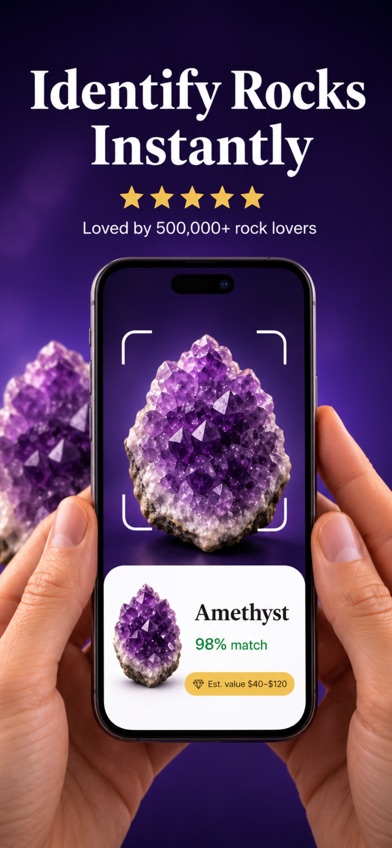
AI Rock ID is an iPhone gemstone identifier app that analyzes a photo and returns a likely specimen name, rarity information, quality indicators, possible treatments, look-alikes, and an estimated value range. That combination fits this search better than a general rock scanner. You can also review Mohs hardness, density, crystal habit, luster, streak, transparency, and chemical formula when the result is a mineral.
The free allowance is unusually easy to understand: five scans per day. Paid access costs $4.99 weekly or $29.99 yearly, so the annual plan costs far less than maintaining the weekly plan for a full year. The US App Store showed 4.6 stars from 576 ratings, with an update on August 3, 2026. That audience is much smaller than Rock Identifier's, partly because AI Rock ID first appeared in March 2025. We rank it first because its confirmed free quota and gemstone-specific output fit the task more closely. Treat any value or authenticity result as an estimate; purchases and insurance decisions still need professional examination.
- Five free scans every day
- Shows gemstone look-alikes and possible treatments
- Includes mineral properties and estimated value ranges
- Requires iOS 18.0 or later and has no verified Android version
- The App Store listing supports one language
- Price
- $4.99 weekly or $29.99 yearly; prices checked October 2026
- Platforms
- iPhone and iPad
Pick AI Rock ID if you want several free daily gemstone scans with value estimates and mineral details.
Rock Identifier: Stone ID
4.7 on the App Store (81,888 ratings)
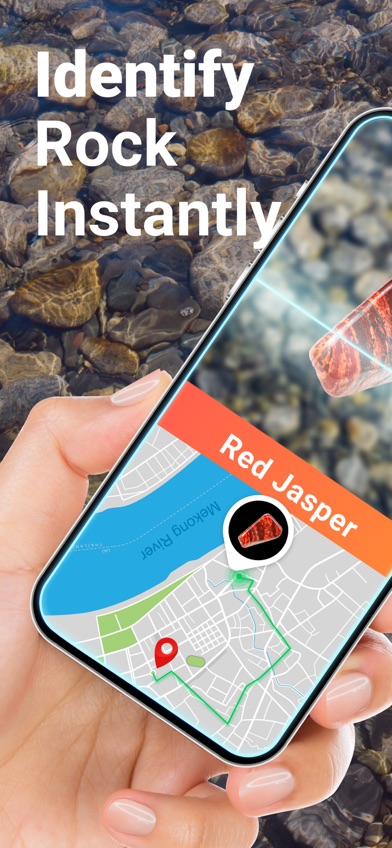
Rock Identifier: Stone ID identifies rocks, crystals, minerals, and gemstones from an uploaded or new photo. Its listing claims coverage of more than 6,000 types and provides names, formulas, hardness, color variations, and common locations. It also has educational articles about visual signs associated with real and imitation gemstones, though those articles cannot authenticate a stone.
The numbers are substantial: 4.65 stars from 81,888 US App Store ratings and a September 23, 2026 update. It supports 14 languages and iOS 15.0 or later, so it reaches far more older iPhones than AI Rock ID. That is where Rock Identifier wins. Pricing is harder to read. The store lists purchases from $3.99 through $69.99, including repeated $39.99 entries, while the exact free daily quota and term attached to every purchase are unclear. Check the checkout screen before accepting a subscription. This is our second pick because its catalog and device reach are strong, but its free allowance and final cost are less transparent.
- More than 81,000 US App Store ratings
- Stated catalog of more than 6,000 types
- Supports 14 languages and iOS 15.0 or later
- Exact free scan quota is unknown
- Several listed purchases have unclear billing terms
- Price
- $3.99 to $69.99 in-app purchases listed; check the term before paying
- Platforms
- iPhone and iPad; an official Android listing was not verified
Pick Rock Identifier: Stone ID if catalog size, language support, or compatibility with an older iPhone comes first.

Crystalyze
4.8 on the App Store (3,422 ratings)
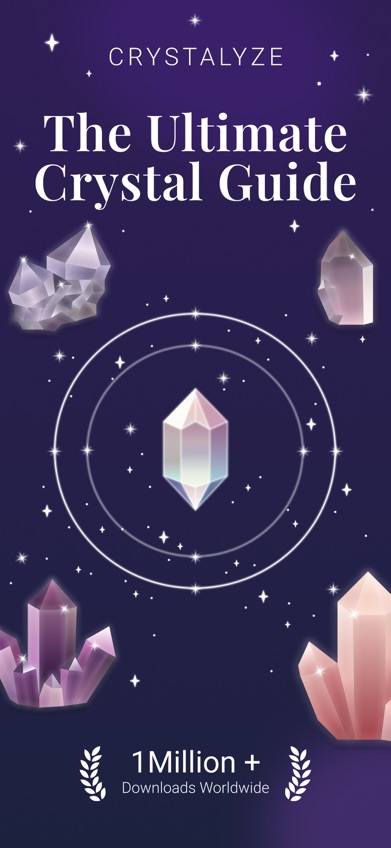
Crystalyze combines photo identification with a library of more than 175 crystals and tools aimed at spiritual crystal use. You can sort saved specimens into Own, Favorites, and Wishlist groups, add private notes, and filter the library by chakra, zodiac sign, planet, element, or stated metaphysical property. Available listing information reports three free identifications per day.
Crystalyze had 4.75 stars from 3,422 US App Store ratings and was updated on October 6, 2026, the most recent iOS update among the ranked picks. Listed purchases include monthly options from $2.99 to $5.99 and annual options from $19.99 to $34.99. Check the in-app screen because multiple prices are active. Crystalyze is a better fit than AI Rock ID if your collection is organized around meditation, astrology, or personal notes. It ranks lower for gemstone buying because much of the app concerns spiritual use, and the reference library is smaller than the 6,000-type catalogs claimed by two rivals. Photo results can still vary with lighting, surface weathering, and the angle of the stone.
- Three reported free identifications per day
- Collection groups and private notes
- Updated in October 2026
- Much of the content focuses on spiritual crystal use
- Multiple subscription prices appear in the store
- Price
- $2.99 to $5.99 monthly and $19.99 to $34.99 annually; prices checked October 2026
- Platforms
- iPhone, iPad, and Android
Pick Crystalyze if you want photo identification tied to spiritual filters and a personal crystal collection.
Rock & Crystal Identifier (Crystal Council)
4.6 on the App Store (2,779 ratings)
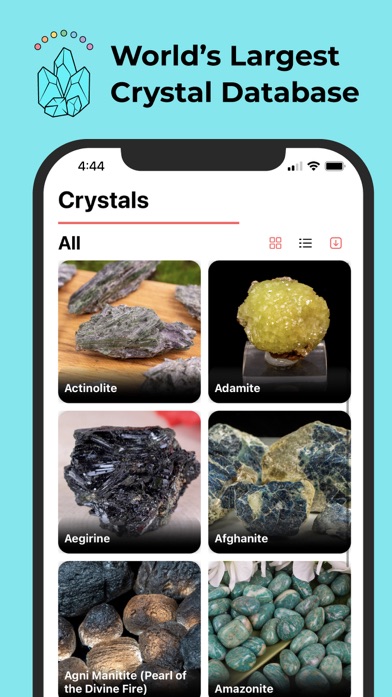
Rock & Crystal Identifier scans raw rocks, polished stones, jewelry, and crystals, then connects the result to a reference catalog. Its listing claims more than 6,000 specimens. Saved scans, identification history, origin details, and personal notes make it useful for building a record of a collection. The app also sorts crystals by color, emotion, chakra, planet, and other spiritual categories.
The US App Store showed 4.57 stars from 2,779 ratings and a September 18, 2026 update. Listed plans cost $1.99 weekly, $5.99 monthly, or $29.99 yearly. The listing says people can try the scanner without a trial or signup, but it does not state a firm current scan quota; check the listing before relying on free access. This app beats Crystalyze on stated catalog size and has a lower listed weekly price. Crystalyze has a confirmed reported daily allowance and a newer update. Rock & Crystal Identifier also mixes identification with shopping and spiritual content, which may distract readers who want mineral data alone. It supports one language and requires iOS 15.6 or later.
- Stated database of more than 6,000 specimens
- Saved scan history, notes, and collection records
- Covers rough stones, polished pieces, and jewelry
- The current free scan quota is unknown
- Only one language is listed
- Price
- $1.99 weekly, $5.99 monthly, or $29.99 yearly; prices checked October 2026
- Platforms
- iPhone and iPad
Pick Rock & Crystal Identifier if you want a crystal catalog with scan history, notes, and spiritual categories.
Crystal Identifier
Crystal Identifier is a web scanner for crystals, minerals, gemstones, rocks, and fossils. You upload a JPG, PNG, WebP, or HEIC image, with a maximum file size of 50 MB. Its results can include a likely name, crystal system, Mohs hardness, formation type, and estimated market value. The site says the scanner works with rough points, clusters, raw specimens, polished cabochons, and tumbled stones.
The main advantage is access: there is nothing to install, and one free scan is available per day without an account. That suits someone who has a single unknown crystal and does not want a subscription prompt. There is no separately verified App Store or Google Play listing for Crystal Identifier, so there is no store rating, mobile update date, or confirmed native collection system to compare. Paid pricing is also unknown; check the site if you need more than the daily scan. This ranks below the native apps because readers searching for an app may want saved scans, camera access, and store-managed billing. For occasional identification from a phone or computer browser, its no-install format is the point.
- One free web scan per day
- No account required for the free scanner
- Accepts several common image formats
- No separately verified native mobile app or store rating
- Paid pricing is unknown
- Price
- One free scan per day; check the listing for paid access
- Platforms
- Mobile and desktop web
Pick Crystal Identifier if you need an occasional crystal scan and do not want to install an app.
Mindat
Mindat is a mineral and locality database accessed through a web browser. Search a suspected mineral name and you can compare specimen photographs, known occurrences, locality records, mineral associations, rocks, and meteorites. It has no one-tap camera result, but it is more useful than a scanner when you already have a candidate and want to see whether the mineral occurs near the collection site.
Reference access does not carry a per-scan charge. Exact account or membership limits were not established, so check the site for services beyond ordinary browsing. Mindat has no separately verified App Store listing in our source set, which means there is no comparable US store rating or mobile update date. It ranks sixth because this page prioritizes quick gemstone identification from a photo. Still, Mindat is the strongest research pick here. A scanner might label a specimen fluorite; Mindat lets you compare photos and locality data before accepting that answer. For cut gemstones, treatments, insurance, or a high-value purchase, database research remains preliminary. A qualified gemologist can take physical measurements that a photograph and locality record cannot supply.
- Detailed mineral and locality records
- Specimen photographs and occurrence data
- No per-scan charge for ordinary reference access
- No one-tap photo identification
- No separately verified native mobile app
- Price
- Free reference access; check the site for other account options
- Platforms
- Mobile and desktop web
Pick Mindat if you already have a possible mineral name and want to verify it against photos and locality records.
AllScan AI
AllScan AI is a general image scanner that includes rocks among many supported object categories. A photo can also be used to identify plants, animals, insects, coins, food, products, antiques, and other objects. That range is useful on a hike, at a flea market, or around the house when you do not want a separate scanner for every category.
For gemstones, breadth comes with a tradeoff. The supplied site information does not confirm the mineral properties, treatment clues, candidate lists, or collection records found in specialist picks. AllScan AI is therefore a starting point for naming an unfamiliar object, followed by a mineral database or professional examination when the result affects a purchase. The web scanner includes one free scan. Paid terms, a recurring free allowance, native store ratings, and current mobile app listing details are unknown; check the listing before paying or uploading more images. AllScan AI ranks below Mindat for mineral research and below AI Rock ID for gemstone-specific output. It wins when the stone is one of many unrelated things you expect to scan.
- Covers rocks and many non-geological objects
- Useful when you do not know the object's category
- One free web scan
- Gemstone-specific result details are not confirmed
- Paid pricing and native store information are unknown
- Price
- One free web scan; check the listing for further access
- Platforms
- Web
Pick AllScan AI if gemstones are only one of many object types you want to identify from photos.

Rockd
4.4 on the App Store (187 ratings)
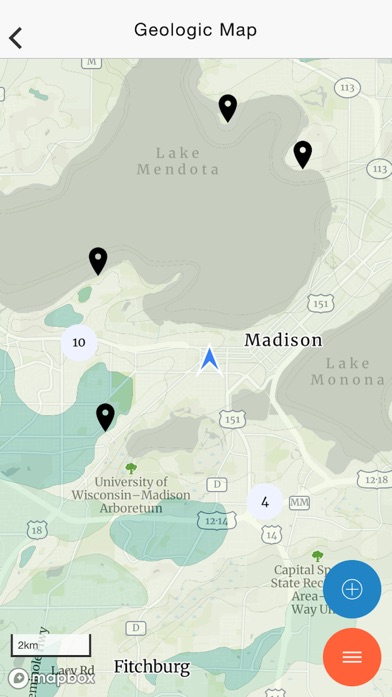
Rockd is a field geology app built around location, maps, and observations. It provides access to more than 290 geologic maps, a 3D globe, data on height above sea level, mapped geologic units, literature links, and stratigraphic columns where available. Maps can be cached for field use, and observations can include strike, dip, trend, or plunge readings.
Rockd is free. Its US App Store listing showed 4.38 stars from 187 ratings and a June 12, 2026 update. The iOS version requires iOS 16.6 or later; Android and web access are also reported. Rockd sits last because it does not take a gemstone photo and return a species name. Use it when location is part of the question: What formations are nearby? Which mapped unit did this rock come from? Where did you record the find? Those details can support later identification, especially for a field specimen with known provenance. Rockd is a better field companion than every scanner above, but someone holding an unknown ring, cabochon, or crystal at home should download a photo identifier first.
- More than 290 geologic maps
- Cached maps and offline field observations
- Free access
- No automatic gemstone identification from a photo
- Less relevant for jewelry and polished gems
- Price
- Free; checked October 2026
- Platforms
- iPhone and iPad; Android and web access are reported
Pick Rockd if you collect in the field and need geological maps, locality context, and observation records.
AI Rock ID vs Rock Identifier: Stone ID
These are the closest matches for someone who wants to photograph a gemstone and get an immediate candidate. AI Rock ID ranks first for transparent free use and gemstone-focused output. Rock Identifier has the larger rating base, broader language support, and lower iOS requirement.
| Point | AI Rock ID | Rival |
|---|---|---|
| Free use | Five scans per day | Limited daily IDs; exact quota unknown |
| Gemstone result | Look-alikes, possible treatments, rarity, and value range | Name, formula, hardness, colors, and locations |
| Annual price | $29.99 yearly | Several purchases listed; exact annual term is unclear |
| US App Store audience | 4.6 stars from 576 ratings | 4.65 stars from 81,888 ratings |
| Device and language reach | iOS 18.0 or later; one language | iOS 15.0 or later; 14 languages |
AI Rock ID is the easier recommendation for a new iPhone owner who wants to know the free limit before downloading. Its results also address gemstone treatments and look-alikes directly.
Rock Identifier wins for older iPhones, language choice, and rating volume. Pick it when those points outweigh uncertainty around the current free quota and subscription term.
What to check before downloading a gem identifier
Photo result or measurement input
Most consumer apps judge color, texture, crystal habit, and surface patterns from a photograph. Those clues can produce a useful shortlist, but they cannot measure refractive index, specific gravity, or internal optical behavior. If you are evaluating a costly cut gem, look for a service that accepts gemological measurements or plan to get an examination from a qualified gemologist.
Free quota and billing term
A free download may include only a few scans. Check the daily quota, trial length, renewal price, and whether the quoted payment is weekly, monthly, or yearly. A $4.99 weekly plan costs about $259 over 52 weeks, while a $29.99 annual plan is a separate decision. Read the final checkout screen because store listings sometimes display several old or active purchase options.
Coverage for your specimen
Raw crystals, weathered rocks, transparent cut gems, mounted jewelry, and synthetic stones present different identification problems. Check whether the listing names your specimen type. A mineral identifier app built for field rocks may give little help with a mounted ring, while a crystal guide may focus on meanings and omit chemical properties. Coverage claims describe intended use, not proven accuracy.
Candidate lists, records, and verification
A useful result explains similar candidates and the visible traits that separate them. Saved photos, notes, locations, and scan history also help when you compare the answer with Mindat or a physical test later. Avoid treating a single label or value estimate as final proof. Purchases, grading, insurance, and authenticity decisions call for professional verification.
Frequently asked questions
What is the best free gemstone identifier app?
AI Rock ID has the best confirmed free allowance in this ranking, with five scans per day. It requires an iPhone or iPad running iOS 18.0 or later.
Is there a truly free mineral identifier app?
Mindat provides mineral photos, occurrence records, and locality research without a per-scan charge. Mindat is a reference website, so it does not identify a gemstone automatically from a camera photo.
Which gemstone identifier app is most accurate?
No listed photo app has verified professional-grade accuracy for every gemstone. Compare multiple candidates and confirm valuable stones with refractive index, density, magnification, or other physical examination.
Can an app tell whether a gemstone is real?
A photo can suggest visual warning signs, but it cannot reliably prove that a gemstone is natural, synthetic, treated, or imitation. Use a qualified gemologist when authenticity affects value.
Can a gemstone identifier app scan mounted jewelry?
Some listings include jewelry, but a setting can hide the stone's underside, inclusions, and other identifying traits. Photograph the piece in even light from several angles and treat the result as preliminary.
What is the best app for rock collecting in the field?
Rockd is the best pick here for field geology because it has more than 290 geologic maps, cached map access, and observation records. Rockd does not automatically identify a gemstone from a photo.
Which crystal identifier saves a personal collection?
Crystalyze saves specimens in Own, Favorites, and Wishlist groups and supports private notes. Rock & Crystal Identifier is another option for scan history and collection records.
Can a gemstone identifier app estimate value?
Some apps provide estimated value ranges, but a photo cannot establish carat weight, treatment status, origin, or laboratory grade. Do not use an app estimate alone for buying, selling, or insurance.
The best gemstone identifier app for most people
Download AI Rock ID if you have a recent iPhone and want the strongest mix of confirmed free use and gemstone-specific results. Choose Rock Identifier: Stone ID for an older iPhone or more languages, Crystalyze for spiritual collection tools, Mindat for mineral research, or Rockd for field geology.
Try AI Rock ID for five free daily gemstone scans
AI Rock ID's strongest checkable advantage is its free allowance: five photo scans per day. That is enough for a small gem-show shortlist, a handful of beach finds, or several stones from an inherited collection without starting a subscription. It suits iPhone and iPad users who want likely names plus look-alikes, mineral properties, and estimated value ranges in one result. Skip it if your device cannot run iOS 18.0 or if you need Android support.