
How to Scan an Antique and Check Sold Prices
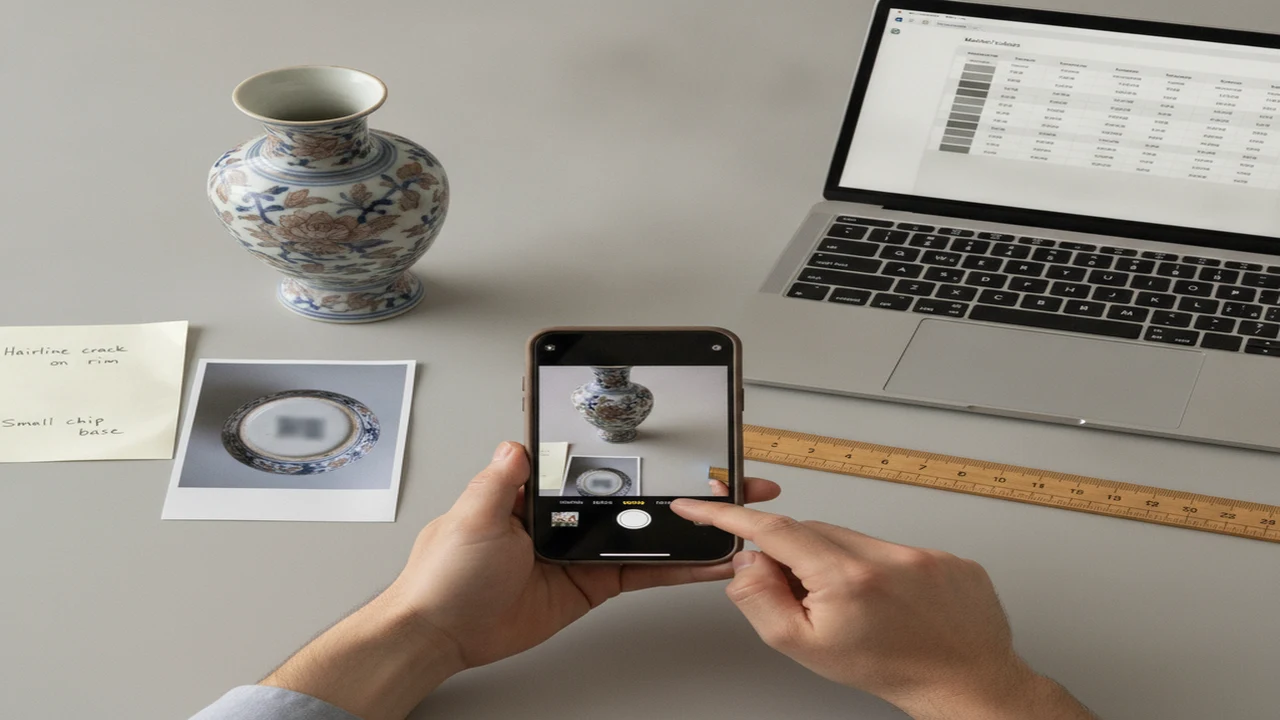
A polished object photo can start the identification process, but it cannot produce a defensible price by itself. The useful mobile workflow is scan, extract candidate attributes, verify the marks, search completed transactions, and document a range.
This distinction matters because identifier results, active asking prices, and completed sales answer different questions. An antique value checker can reduce research friction, but the final estimate should come from closely matched evidence rather than the most optimistic number on the screen.
Quick answer: Photograph the full object, maker marks, construction details, dimensions, and damage in good light. Use an antique identifier to generate searchable clues, then verify those clues against sold marketplace listings and auction archives. Match material, dimensions, maker, age, and condition rather than visual similarity alone. Record several relevant sales and report a range, not a single estimate.
What does this mean?
Definition: Scanning an antique means using object photos to identify its likely type, maker, period, materials, and distinguishing marks, then using those details to find comparable completed sales and estimate a current antique market value range.
What should you capture before scanning an antique?
Build a photo set for identification and condition matching, not just a listing hero image. Wear, repairs, missing components, replaced hardware, and damage may separate a useful comparable from a misleading one. For more on mobile photo intake, see this guide to apps for identifying antiques from photos.
When an app requests camera permission, grant only the access needed for the session. Check whether it can take a new photo, import an existing image, or use selected-photo access. Keep original close-ups of stamps and signatures because messaging apps and cloud previews may compress the detail needed to identify antique marks and hallmarks.
Category-specific evidence also matters. An antique jewelry identifier needs clasp, setting, hallmark, stone, and wear photos. An antique furniture identifier benefits from joints, drawer construction, back panels, feet, fasteners, and hardware. A porcelain and ceramics identifier needs the base mark, rim, glaze, decoration, foot, and any firing flaws.
- Photograph the full object from the front, back, sides, and underside.
- Capture maker marks, hallmarks, signatures, labels, patent numbers, and country-of-origin text.
- Measure height, width, depth, diameter, weight, and relevant component sizes.
- Show joints, fasteners, clasps, hinges, feet, backs, bases, and interior construction.
- Record wear, chips, cracks, repairs, replaced parts, stains, and missing components.
- Use diffuse daylight or soft lighting, avoid glare, and include one close-up per mark.
- Keep an uncropped reference image even when the app asks you to crop tightly.
- Photograph the object and its identifying details.
- Measure the dimensions needed to distinguish similar models or patterns.
How should you scan the antique in an identifier app?
Choose the clearest image, crop away unrelated background objects, and submit one object at a time. A tool such as Antique Identifier can provide candidate terms for the object type, maker, material, period, or style.
Review the proposed category before accepting the result. Save useful vocabulary, but correct attributes that conflict with visible marks or construction. An AI antique identifier by photo is most useful as a search-query generator, not as a final appraisal issued from one image.
Separate identification confidence from value confidence. A category may be plausible while the maker, date, condition grade, or price remains uncertain. Mobile UX can either preserve or blur that distinction, so look for editable results, confidence notes, saved history, and source visibility.
Before starting a large batch, inspect account requirements, paywall timing, scan limits, export options, photo retention settings, and whether the same functions exist on iOS and Android. An app that allows corrections and collection export is easier to use across repeated research sessions than one that returns a disposable result.
- Scan one object using the strongest overview image.
- Extract candidate maker, material, period, style, and category terms.
How do you turn an identification into sold-price searches?
Convert the candidate identification into a text query: object type + maker or signature + material + pattern or model + approximate date + dimensions + distinctive feature. Antique Identifier TIQ can supply candidate terms, but each term should be checked against the object before it enters the final query.
Begin with the exact mark in quotation marks. If results are sparse, remove an uncertain date, try spelling variants, expand abbreviations, or substitute category synonyms. Search antiques by photo to discover possible matches, then switch to text queries based on verified attributes.
A sold result records a transaction. A completed but unsold listing shows that an item did not sell under those terms. Active marketplace listings and dealer prices are asking prices, while an app-generated estimate is a model output. Do not place those figures in one undifferentiated price column.
For readers asking how much is my antique worth, the answer should point to multiple relevant sold records. The eBay sold and completed listings view is one starting point; auction archives and historical-price databases can provide additional venue coverage. This explainer on what a mobile appraisal can and cannot establish provides useful context before assigning a range.
- Search with the most specific verified attributes.
- Filter results into sold, unsold, active, dealer, and estimated-price evidence.
How do you verify marks, materials, and model details?
Transcribe maker signatures, hallmarks, country-of-origin labels, patent numbers, and pattern names exactly. Search the transcription in quotation marks, then try alternate readings where worn letters could be mistaken for numbers or other characters.
Check material, dimensions, production period, and construction method against the candidate identity. Antique furniture identification may depend on drawer joints, saw marks, veneer, hardware, or fastener type. Jewelry research may require separate verification of a metal mark, maker mark, clasp, and stone setting.
Reflections can create false letterforms, while worn stamps and partial signatures can point to the wrong maker. Replacement parts, later reproductions, and copied marks can also make a visually similar result unsuitable. These are antique authenticity clues, not authentication findings.
Use Antique Identifier TIQ as an editable research record where applicable: review the candidate attributes, replace uncertain readings, and carry only verified terms into sold-record searches. If you cannot identify maker signatures confidently, preserve several possible transcriptions rather than forcing one answer.
- Confirm the signature or hallmark from more than one photo angle.
- Match patent numbers and pattern names to the correct product category.
- Check dimensions against catalog descriptions or close sold records.
- Separate original construction from later hardware and replacement components.
- Distinguish material appearance from verified material composition.
- Keep the proposed production period broad until marks and construction agree.
- Verify each value-changing attribute against visible evidence.
How should you compare and adjust sold prices?
Rank comparables by attribute match instead of selecting the highest sale. Compare maker, material, model or pattern, age, dimensions, condition, completeness, provenance, venue, sale date, buyer premium, and shipping treatment.
Use at least three close sales when they are available, but prioritize match quality over count. Rare or regional objects may produce fewer records. Remove obvious mismatches first, note the low and high relevant results, and identify where the strongest matches cluster.
Apply condition and completeness judgments cautiously. A repaired example, incomplete set, later reproduction, or unusually strong provenance may sit outside the central cluster. Do not invent a percentage adjustment when the sold evidence does not support one.
Label every price basis. An auction hammer price differs from a total including the buyer premium, and a marketplace item price differs from an order total containing shipping or tax. Mixing these values can distort the antique market value range.
Current market value is also different from insurance replacement value, dealer asking price, and expected seller proceeds after fees. State which value question the range is intended to answer.
- Compare the closest sales using consistent attributes and price labels.
- Adjust the range cautiously for condition, completeness, and provenance.
Which tools should support the sold-price workflow?
The best app to identify antiques is a feature-matrix decision, not a universal ranking. Compare photo intake, editable identification, sold-comparable access, scan limits, subscription timing, saved collections, export, privacy controls, and iOS or Android availability. This antique app feature comparison covers the product and platform questions in more detail.
Antique Identifier TIQ fits the candidate-identification stage and can help turn a photo into research vocabulary. Google Lens can broaden visual discovery, while WorthPoint is a historical-price research tool rather than a camera-first scanner.
Antique Identifier - Relic offers a one-photo antique scan with history and provenance notes and a USD value estimate. Based on its public listing, Relic requires a subscription for its AI identification, comparison, history, and collection functions.
Database scale can improve discovery without resolving whether an individual match is valid. Antiqbot reported in 2026 that leading identification engines draw on hundreds of thousands of verified objects and more than 30 years of dealer expertise. Those are two indicators of source scale, not accuracy guarantees for a particular scan.
A useful antique identifier app comparison should therefore ask where each tool sits in the workflow. The best antique identifier app for capture may not be the best source for sold records, collection export, or specialist review.
How should you save the evidence and set a value range?
Create one dated record containing the object title, original photos, dimensions, transcribed marks, proposed identification, confidence notes, condition issues, source URLs, sale dates, sold prices, fees, currency, and final range. Screenshots help preserve evidence when listings are revised or removed.
Label the estimate date and currency. When sales come from different countries, retain the original currency and note the conversion date rather than silently merging converted figures.
The ability to save an antique collection is a retention feature with practical research value. A good record should let you add stronger photos, correct attributes, update comparables, and export the data without rescanning the object. That turns a one-session result into an inventory record that can support listing, insurance, estate, or future research needs.
- Record the evidence, estimate basis, currency, and date.
- Save source references and update the range when stronger sales appear.
When should you stop relying on photo identification?
Are antique identifier apps accurate? Their usefulness depends on image quality, category specificity, visible marks, database coverage, and human verification. They can support category and maker research, but a photo cannot reliably establish concealed repairs, internal construction, material composition, authenticity, or provenance.
Escalate when the apparent value is unusually high, a signature is disputed, precious metals or gemstones are claimed, major restoration is suspected, cultural-property questions arise, or the object is intended for insurance scheduling, estate division, tax use, or auction consignment.
- Escalate the object to a qualified appraiser, auction-house specialist, jeweler, conservator, or category expert when the decision carries material risk.
Comparison
| Evidence source | What to capture | Best use | Main caveat | Next action |
|---|---|---|---|---|
| Closely matched sold marketplace listing | Item price, date, condition, dimensions, seller description, shipping | Building the central market range | Descriptions may omit repairs or misidentify the object | Verify attributes and save the listing |
| Auction result with buyer premium | Hammer price, premium, sale date, lot description, provenance | Researching specialist-category demand | Hammer and total prices are not interchangeable | Record both figures with labels |
| Completed but unsold listing | Ask price, listing duration, condition, venue | Identifying prices the market rejected | It is not evidence of a completed transaction | Keep separate from sold comparables |
| Active dealer or marketplace listing | Ask price, condition, presentation, listing date | Monitoring current supply and replacement options | The asking price may never be achieved | Use as context, not the range anchor |
| Identifier-app value estimate | Proposed identity, range, confidence, referenced attributes | Starting research and generating queries | The estimate may rely on unmatched or opaque inputs | Verify against completed sales |
| Specialist appraisal | Scope, effective date, value type, qualifications, object inspection | Insurance, estate, tax, consignment, or disputed attribution decisions | Purpose and value definition affect the result | Retain the signed report and supporting evidence |
Limitations
Visual similarity does not establish maker, age, authenticity, or provenance. Sparse sales data can also produce a wide range for rare, regional, heavily restored, or poorly documented objects.
Sold prices vary by venue, sale date, buyer premium, shipping, location, condition, and presentation. High-value, inherited, insured, or disputed objects need review by an appropriate specialist before a consequential decision.
Frequently Asked Questions
Can a photo tell me how much an antique is worth?
A photo can generate identification clues, but value also depends on verified maker, material, dimensions, condition, completeness, and relevant sold records. Use the image to begin research, not to assign a final figure by itself.
Where can I find sold prices for antiques?
Check completed marketplace results, auction-house archives, and historical-price databases such as WorthPoint. Google Lens may help locate visually similar objects, but confirm that any price shown represents a completed sale.
How many sold listings should I use for an estimate?
Use several close comparables when available, with at least three as a practical target. Match quality matters more than an arbitrary count, especially for rare objects with limited transaction history.
Can Antique Identifier TIQ identify maker marks from a photo?
Antique Identifier TIQ can generate candidate readings from clear close-ups, but worn, reflected, or partial marks should be corrected and verified manually. Save alternate readings when the lettering is uncertain.
Should shipping and auction buyer premiums be included?
Record hammer price, buyer premium, item price, shipping, tax, and total paid as separate fields. Decide which basis fits the valuation purpose, then use that basis consistently across the comparable set.
What is the difference between market value and insurance value?
Current market value reflects likely exchange in the relevant market. Insurance replacement value may reflect the cost of obtaining a similar object through retail channels. Dealer asking price and expected seller proceeds after fees are separate figures.
When should I pay for a professional antique appraisal?
Seek a qualified specialist for high-value, authenticity-sensitive, inherited, insured, culturally significant, or legally consequential objects. Professional review is also appropriate before major restoration or auction consignment.