
Can a Mobile App Really Appraise an Antique?
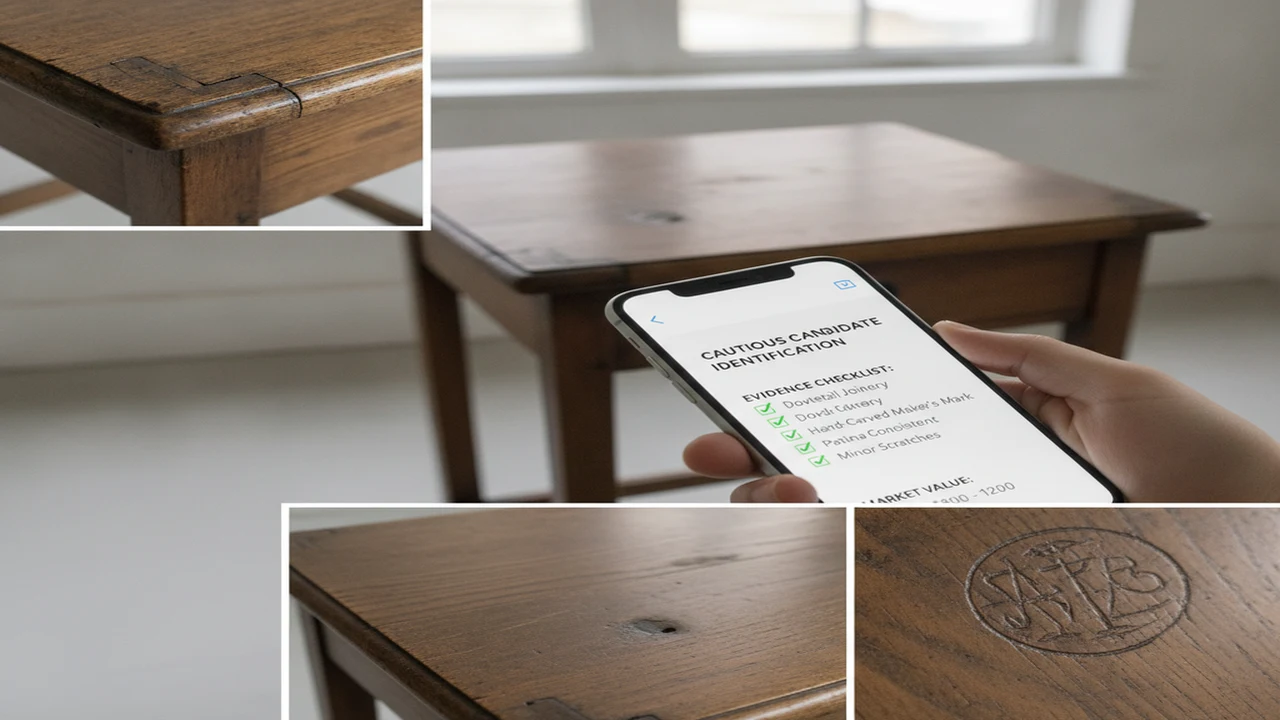
Pointing a phone camera at an inherited chair or silver dish can start useful research. The harder product question is what the result screen means. A likely category, a visual match, and a price estimate are separate outputs, each supported by different evidence.
For owners asking “how much is my antique worth,” the strongest mobile workflow is not a single number. It is a chain of identification, evidence capture, comparable research, saved documentation, and escalation when the decision requires specialist judgment.
Quick answer: A mobile app can suggest an identification, surface comparable objects, and estimate an antique market value range. It cannot produce a formal appraisal from a photo alone. Results depend on image quality, visible marks, condition details, provenance, regional demand, the relevant sale channel, and the availability of credible completed-sale data.
What does this mean?
Definition: An antique appraisal is a supported opinion of value for a specific object, purpose, market, and date; an antique identifier app usually provides image-based identification and pricing guidance rather than a documented professional valuation.
What does an antique appraisal app actually do?
Most apps begin with camera capture or a photo-library upload. An image model proposes a category, object type, style, maker, material, or period. The user then reviews visual clues, possible matches, historical context, and pricing guidance.
Identification is the classification layer. An antique identifier by picture might label an object as a Victorian-style side table or a silver-plated serving dish, but classification alone does not establish age, authenticity, condition, provenance, or insurable value.
Price guidance is a separate layer. An AI antique identifier may use visually related objects, reference records, or market examples to suggest a range. Its usefulness depends on whether the result explains the market, condition assumptions, sale dates, and degree of uncertainty.
A formal appraisal goes further. It identifies the object being valued, defines the valuation purpose and market, documents relevant evidence, applies specialist judgment, and provides an effective date. Apps are generally strongest at supporting antique identification and value research before that stage.
Which parts of an antique can a photo reveal?
A clear photo can reveal overall shape, decoration, construction style, wear patterns, surface finishes, visible materials, fasteners, joinery, labels, maker signatures, and hallmarks. Multiple views help an antique furniture identification workflow distinguish a period construction clue from a later repair.
For furniture, photograph the front, sides, back, underside, drawer joints, feet, hardware, and damaged areas. For porcelain and ceramics, capture the profile, base, glaze, decoration, chips, foot rim, and factory mark. Antique silver identification benefits from sharp images of hallmarks, monograms, seams, handles, and areas of worn plating.
Include a ruler or familiar scale reference without covering the object. One wide room photo rarely provides enough evidence. Glare, low resolution, filters, heavy restoration, missing marks, and poor focus all reduce the usefulness of features that search antiques by photo.
Camera and photo-library permissions are onboarding decisions, not administrative details. A useful permission prompt should explain that image access is needed to classify the object and inspect marks. Asking at the moment of capture gives the user more context than requesting broad access immediately after install.
Why can an app identify an object but still misjudge its value?
Objects can look nearly identical while differing in maker, period, dimensions, material, rarity, restoration, provenance, and authenticity. A model may recognize the broad type correctly while selecting market examples from a more valuable version.
The question “how much is my antique worth” also needs a market, condition, sale date, location, and purpose. A dealer purchase expectation, local auction estimate, online marketplace result, and retail replacement figure can differ substantially even when they describe the same object.
Asking prices show what sellers hope to receive. Completed-sale prices show that a transaction occurred, although fees, shipping, lot composition, and undisclosed condition can still affect interpretation. An antique price guide may also lag changing demand or omit regional auction outcomes.
Reproductions, later copies, altered pieces, and objects assembled from parts are particularly difficult to resolve from photographs. A plausible visual match should therefore lead to evidence checks rather than immediate acceptance of the displayed value.
What should a useful antique identifier app show after a scan?
Use the feature matrix below as a product-evaluation checklist, not a ranking. The result should distinguish a candidate identification from supporting clues and market guidance. A range with stated assumptions is more actionable than an unexplained single price.
The screen should also provide a next step: add a mark photo, correct the category, enter dimensions, record condition, save the object, export the research, or request specialist review. These actions determine whether the first session becomes useful documentation rather than a novelty scan.
AntiqSnap: Antique Identifier is one example in this category. Its listing emphasizes photo identification, pricing guidance, condition suggestions, collection tracking, collector learning articles, and unlimited premium scans. Those listing claims should still be evaluated against the evidence and controls shown in each result.
How should you photograph an antique for a more useful result?
Good capture guidance can reduce first-session failure. If the first image is blurred or hides the identifying evidence, prompting a retake before processing is more useful than returning a confident but weak match.
- Position the object on a stable surface where the full shape is visible. Do not dismantle it or remove labels for the photograph.
- Light it with even, neutral light. Avoid glare, deep shadows, flash reflections, color filters, and artificial background effects.
- Frame the front, back, sides, top, underside, base, and interior where access is safe. Keep the object sharp and fill most of the image.
- Measure height, width, depth, diameter, and weight where appropriate. Include a ruler in a separate scale photo.
- Capture close-ups of damage, repairs, labels, hallmarks, serial numbers, signatures, joinery, and hardware. These details help identify antiques by photo.
- Zoom by moving closer while preserving focus rather than relying on heavy digital enlargement. Photograph marks straight on.
- Record provenance, previous owners, receipts, inscriptions, and known restoration separately. Do not clean or polish the object merely to improve the picture.
- Verify that letters and symbols remain readable before submitting. Retake weak images when trying to identify antique marks and hallmarks.
- Save the original, unfiltered photographs so future research can return to the same evidence.
How can you verify an app-generated identification and price range?
Record the proposed category, maker, period, material, visible clues, and value assumptions before opening another search. This preserves the original result if later edits or rescans change it.
Check museum collection records, auction archives, maker references, hallmark directories, catalogues, and completed-sale evidence where available. WorthPoint can supplement this process with pricing and collection-reference tools described in its public App Store listing. Google Lens can surface visual leads, but neither tool should replace object-level verification.
Compare dimensions, marks, materials, construction, condition, sale date, and lot details. Visual resemblance alone is weak when the comparable has a different maker, scale, material, or restoration history. Our guide to scanning an antique and checking sold prices covers that second-step workflow.
Save citations, screenshots where permitted, object photographs, dimensions, and corrections in a collection record. A durable research trail makes it easier to explain why an identification changed and prevents a later rescan from erasing useful context.
When is a professional appraiser still necessary?
Seek an appropriate professional appraisal for insurance, estate administration, tax or donation documentation, litigation, secured lending, high-value sale planning, or disputed attribution. These decisions may require inspection, market analysis, a stated valuation basis, and a signed report.
The requested purpose matters. Replacement value, fair market value, auction value, and a dealer purchase expectation answer different questions. Confirm which basis the insurer, institution, lender, or adviser requires rather than assuming an app’s price range fits the decision.
Specialist review is also sensible when an object may be rare, heavily restored, unsafe to handle, made from regulated material, or vulnerable to damage. Bring photographs, dimensions, provenance, receipts, prior reports, and the app result as background material.
If the immediate decision is where and how to sell rather than formal documentation, review antique apps by UX, cost, and platform and assess whether their pricing workflow matches the intended marketplace. For legal or tax decisions, obtain advice from a qualified professional in the relevant jurisdiction.
What are the limitations of appraising antiques by picture?
Image-based output depends on visible evidence, reference coverage, relevant comparable sales, and accurate user inputs. The following constraints should be reviewed before acting on a match or value range.
- A photograph cannot reveal hidden construction, weight, sound, odor, internal components, or every restoration.
- Look-alike reproductions and later copies may share the visible features used for image matching.
- Material, wood, metal, glaze, and stone suggestions can be wrong when lighting or surface treatment changes appearance. User reviews of AntiqSnap: Antique Identifier have reported incorrect wood or material suggestions and difficulty distinguishing reproductions from genuine antiques; these are user reports, not verified findings.
- Pricing depends on condition, location, sale channel, buyer demand, fees, and the date of comparison.
- Asking prices and visually similar listings are not equivalent to verified completed sales.
- Sparse categories, obscure makers, regional objects, and undocumented workshop pieces may produce weak matches.
- Room photos and collection records can expose personal details, location metadata, inherited documents, signatures, or collection locations. Crop unrelated details and review app privacy controls before upload.
- iOS and Android availability, subscription terms, scan allowances, exports, and other features can change after the article date. A capability missing from public documentation is not proven absent.
How should you choose an antique identifier app?
Begin an antique identifier app comparison with category fit. Check support for the objects you are likely to scan, such as furniture, ceramics, silver, jewelry, clocks, or mixed household items. Broad category claims are less useful than evidence-rich results in your actual collection.
Review multi-photo input, confidence wording, visible clues, date and maker context, condition prompts, comparable-sale explanations, correction controls, and value assumptions. An antique value checker should explain why a range applies and let the user correct an obviously wrong category.
Inspect onboarding friction before subscribing: account requirements, camera permission timing, first-scan instructions, paywall placement, and whether the user can obtain one useful result before payment pressure. Also check whether denied camera access leaves a clear photo-library path.
Retention value comes from saved records, editable notes, rescan history, exports, and collection management. These features support repeat research and insurance preparation more effectively than isolated scans with no history.
Finally, review the current iOS or Android listing, update recency, support documentation, scan limits, privacy controls, subscription renewal terms, and cancellation steps. For a broader category shortlist, see our guide to the best mobile apps for identifying antiques.
Comparison
| Result feature | What it should provide | User check | Decision risk |
|---|---|---|---|
| Candidate identification | Several plausible categories or matches | Does the label fit every visible feature? | A broad visual match may be accepted as exact. |
| Date or period range | A range with supporting style or construction clues | Is the range explained rather than asserted? | Revival styles can be mistaken for earlier originals. |
| Maker or origin | Possible maker, workshop, region, or country | Do marks and construction support the attribution? | A famous maker can inflate the estimate. |
| Materials and construction | Visible material and assembly observations | Were finish, grain, seams, joinery, or glaze considered? | Surface appearance may produce a wrong material. |
| Marks and signatures | Transcription and interpretation of visible symbols | Can the mark be read in the original photo? | Partial or copied marks may mislead. |
| Condition prompts | Questions about damage, repairs, wear, and missing parts | Can the user add close-ups and notes? | Unrecorded restoration can distort value. |
| Comparable-sale context | Dates, channels, dimensions, and condition context | Are these completed sales or asking prices? | Weak comparisons can create false precision. |
| Market value range | A range tied to assumptions and a market | Is the purpose and effective date clear? | One unexplained number may be misused. |
| Authenticity clues | Evidence to inspect rather than a binary claim | Does the app identify conflicting clues? | Photos may not resolve reproductions or alterations. |
| Saved collection record | Photos, notes, sources, edits, and export controls | Can the record be corrected and exported? | A closed record may lose its research history. |
Limitations
Privacy deserves the same attention as identification quality. Review whether uploads are retained, whether location metadata is preserved, and whether collection exports reveal addresses, signatures, receipts, or other personal information.
Store listings are snapshots. Platform support, pricing, scan allowances, export formats, and result-screen features may change after August 6, 2026, so recheck the current listing before installation or renewal.
Frequently Asked Questions
Can a photo tell whether an antique is genuine?
Not reliably on its own. A photo may reveal construction, marks, wear, or inconsistencies, but authenticity can depend on hidden materials, internal components, provenance, restoration, and physical inspection.
How accurate is an AI antique identifier?
Accuracy varies by category, image quality, reference coverage, and how distinctive the object is. Judge the result by its supporting clues, confidence wording, and ability to accept additional photos rather than by the confidence of the headline.
Can an app identify antique furniture from a picture?
It can propose a furniture type, style, period, material, or maker from visible evidence. Antique Identifier TIQ is one example of an AI antique identifier by photo, but useful furniture research still requires underside, joinery, hardware, dimension, and mark photos.
What photos should I take of maker marks and hallmarks?
Take one context photo showing where the mark appears, then sharp close-ups from directly above. Use neutral light, include scale, capture every symbol, and avoid polishing the surface before photography.
Can an antique identifier app provide an insurance value?
An app may provide preliminary pricing guidance, but insurers generally require documentation based on their specified valuation purpose and format. Ask whether they need replacement value, an inspection, supporting comparables, or a signed appraisal.
Is Google Lens enough to identify an antique?
Google Lens is useful for visual discovery and finding related pages or objects. It is not a formal antique price guide, and visually similar results still need checks for dimensions, materials, marks, condition, and sale date.
Can I save multiple objects as an antique collection?
Some apps provide collection records with photos, notes, estimated values, and history. If considering Antique Identifier TIQ or another option, check whether records are editable, exportable, backed up, and available after a subscription ends.
Should I pay for unlimited antique scans?
Only if repeat scanning supports a continuing job such as cataloguing a collection, researching inventory, or recording an estate. Check category quality, correction tools, saved history, renewal terms, and whether unlimited scans are subject to fair-use or platform restrictions.